
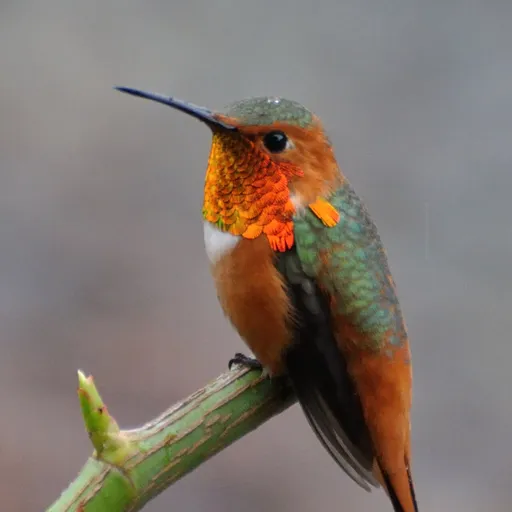
Allen's Hummingbird
Selasphorus sasin
Least Concern
Overview
Allen's hummingbird (Selasphorus sasin) is a small species of hummingbird that breeds primarily in the western United States. It is one of seven species in the genus Selasphorus and is currently classified as Least Concern on the IUCN Red List.
Identification
- Males display a green back and forehead with rust-colored flanks, rump, and tail, and possess an iridescent orange-red throat; females and immatures lack this patch, featuring throat speckles instead.
- Adults measure only 3 to 3.5 inches (76 to 89 mm) in length and weigh between 2 and 4 grams.
- The second rectrix lacks a notch, a key field mark distinguishing adult males from rufous hummingbirds.
- Immature birds are nearly indistinguishable from female rufous hummingbirds in the field.
Habitat
Allen's hummingbirds breed along coastal forests and shrub areas from California to Oregon, frequently utilising brushy woods, gardens, and meadows. They migrate to central Mexico for the winter, though populations on the Channel Islands and in southern California often remain as year-round residents.
Diet
Feeding frequently to support a high metabolic rate, Allen's hummingbirds consume nectar from flowers and small insects such as flies, ants, beetles, spiders, and tiny wasps. They forage in flight or on flower blossoms, a process that also aids in the pollination of species like the Western lily.
Did you know?
Males perform a frantic courtship flight involving a pendulum-like arc followed by a high-speed dive from approximately 100 feet, during which their tail feathers emit a sharp flutter to attract females.
Sources
- Wikipedia · CC BY-SA 4.0
- Wikidata · CC0 1.0