
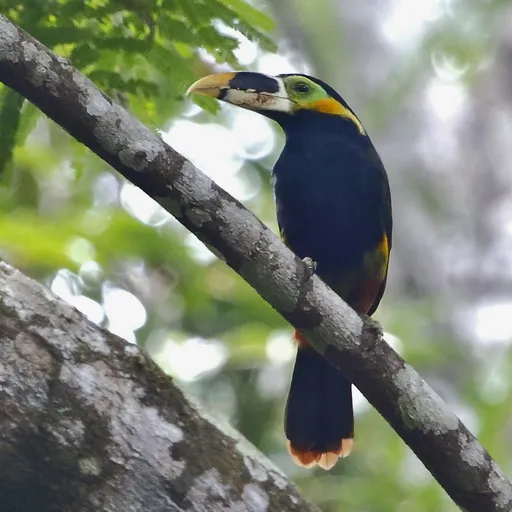
Gould's Toucanet
Selenidera gouldii
Least Concern
Overview
Gould's toucanet (Selenidera gouldii) is a near-passerine bird in the toucan family Ramphastidae, found in central and eastern Brazil and eastern Bolivia. It is a year-round resident that inhabits a variety of tropical forest types, primarily wet lowland and gallery forests. The species is currently assessed as Least Concern by the IUCN, though its population is believed to be decreasing.
Identification
- Approximately 33 cm long, with males weighing 138 to 209 g and females 131 to 183 g; females have shorter bills than males.
- Adult males feature a black head, nape, chin, throat, and belly, with green upperparts marked by a yellow band on the lower neck, yellow flanks, and red undertail coverts.
- Females have chestnut plumage where males are black, yellower flanks, and a narrower yellow band on the back; both sexes possess bare green-yellow to blue skin around the eye with a golden-yellow tuft behind it.
- The bill displays a narrow white base, black middle, orange-yellow outer third, and ivory 'teeth' along the tomium, while the mandible has an ivory inner half and orange-yellow outer end.
- Vocalisations consist of a series of 'ggrawnk' to 'ggrraaw' notes or a very low, croaking 'porc-porc-porc-' sound.
Habitat
The species is distributed across central and eastern Brazil south of the Amazon River and into eastern Bolivia and the Brazilian state of Mato Grosso. It inhabits various tropical forest types, including wet lowland, gallery, palm, deciduous, and secondary forests, favouring tall vegetation up to 40 m high but occurring in shorter trees on sandy soils. Its elevation range extends up to 800 m in eastern Amazonia.
Diet
Gould's toucanet forages from the undergrowth to the canopy, typically in pairs or groups of up to four. Its diet includes fruit and some animal matter, although specific details are lacking.
Did you know?
The bird is named after the English ornithologist and bird artist John Gould (1804–1881). Its breeding season is thought to occur between May and September, but its nest, eggs, and incubation period remain unknown.
Sources
- Wikipedia · CC BY-SA 4.0
- Wikidata · CC0 1.0