
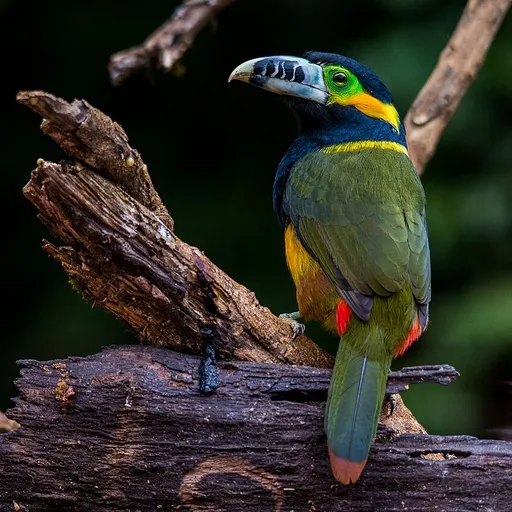
Spot-billed Toucanet
Selenidera maculirostris
Least Concern
Overview
The spot-billed toucanet (Selenidera maculirostris) is a near-passerine bird within the toucan family Ramphastidae. It is currently classified as a species of Least Concern by the IUCN Red List, although its population is believed to be decreasing.
Identification
- Measures 33 to 37 cm in length and weighs between 137 and 193 g.
- Males possess a black head, nape, throat, and belly, while females display chestnut to cinnamon-rufous plumage in these areas.
- The bill is mostly ivory at the base transitioning to greenish-yellow at the tip, featuring a thin vertical black line at the base, three to five vertical black stripes on the maxilla, and a black patch on the mandible near the end.
- Both sexes have bare green-yellow to blue skin around the eyes, accompanied by a golden-yellow tuft of feathers behind the eye, which appears paler in females.
- Vocalisations include gruff, growling notes such as 'ggrooaw' or 'kkrowk' in series, often sung by one sex at a time, alongside low 'tut' notes, rattling sounds, purring, and bill-snapping.
Habitat
Found in the Atlantic Forest regions of Brazil, eastern Paraguay, and Argentina's Misiones Province, ranging in elevation from sea level to at least 1,000 m. It inhabits old-growth and secondary forests, selectively logged and remnant forests, palm groves, and gallery forests at the edges of the cerrado.
Diet
Forages from the undergrowth up to the mid-storey of the forest, typically operating singly, in pairs, or in small groups. Its diet consists of fruit, including species such as Euterpe and Cecropia, and some vertebrates, though detailed feeding behaviour in the wild is not fully understood.
Did you know?
The bird is a year-round resident across its entire range and breeds in tree cavities with clutch sizes of two or three eggs, an incubation period of approximately 15 days, and a fledging time of six to seven weeks as observed in captivity.
Sources
- Wikipedia · CC BY-SA 4.0
- Wikidata · CC0 1.0