
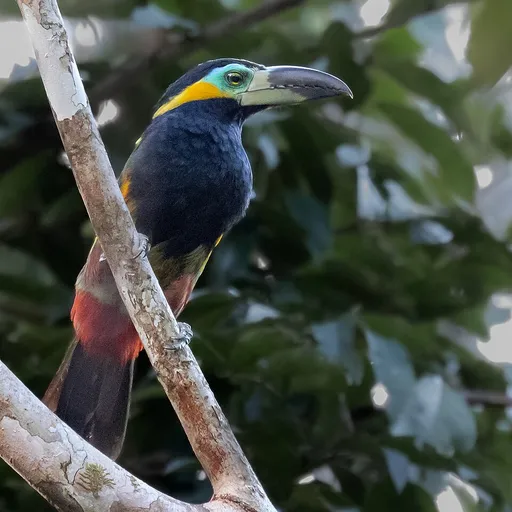
Golden-collared Toucanet
Selenidera reinwardtii
Least Concern
Overview
The golden-collared toucanet (Selenidera reinwardtii) is a near-passerine bird belonging to the toucan family Ramphastidae. It is a forest-dwelling species found in parts of South America and is considered a good indicator species for strictly forest-dependent birds.
Identification
- 33 to 35 cm in length, with plumage varying by sex: males have a black head and shoulders, while females have a chestnut head and shoulders.
- A narrow yellow band separates the black or chestnut shoulders from the green back, and both sexes possess a golden-yellow tuft of feathers behind an eye surrounded by bare blue skin.
- Bills differ between subspecies: the nominate has a red bill with black markings, while S. r. langsdorffii has a mostly black or greenish bill; females have shorter bills than males of the same subspecies.
- Underparts are mostly black in males and chestnut in females, featuring gold-yellow flanks and red undertail coverts in adults.
Habitat
The species inhabits the interior and edges of montane forest, forest in floodplains, and occasionally várzea, favouring drier uplands while shunning secondary forest. Its range covers south-central and southeastern Colombia, eastern Ecuador, Peru, western Brazil, and northwestern Bolivia, typically found at elevations up to 1,000 m but occasionally higher.
Diet
The golden-collared toucanet forages singly, in pairs, or in small groups from the understory to the canopy, often joining mixed-species flocks. Its diet consists mostly of fruit, but also includes insects and possibly small birds, obtained by gleaning from foliage or hawking for flying insects.
Did you know?
During aggressive encounters, the bird loudly wipes its bill on a branch. It is considered a suitable indicator species because, unlike many other toucans, it is a strictly forest-dwelling species.
Sources
- Wikipedia · CC BY-SA 4.0
- Wikidata · CC0 1.0