
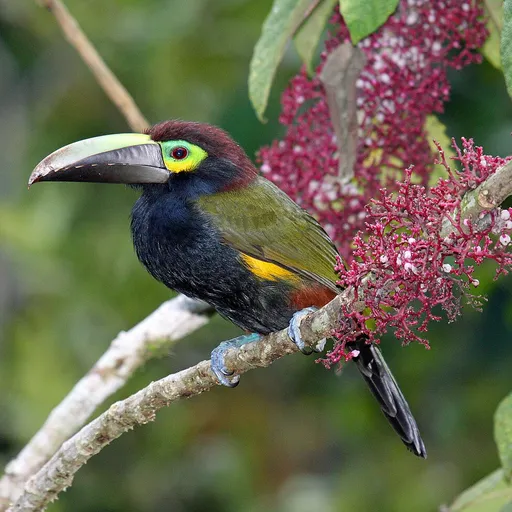
Yellow-eared Toucanet
Selenidera spectabilis
Least Concern
Overview
The Selenidera spectabilis is a near-passerine bird within the toucan family, Ramphastidae. It is monotypic and considered the largest and most distinctively plumaged member of its genus.
Identification
- Size: 36 to 38 cm long, weighing 175 to 245 g.
- Males: Feature a black cap extending down the hindneck, blue to green bare skin around the eye, and a large yellow tuft behind the eye; the back and uppertail coverts are green with a blackish tail.
- Females: Possess a chestnut forehead and hindneck, lack the male's yellow ear tuft, and have a shorter bill than males.
- Bill: The maxilla is yellow with an olive-brown triangle narrowing from the base and horn-colored tips on the tomium; the mandible is dark olive to brownish black.
- Song: A short to long series of double notes described as 'tik-ett', sometimes accompanied by bill snapping or rattles.
Habitat
Found from northeastern Honduras south through Nicaragua, Costa Rica, Panama, western Colombia, and into northwestern Ecuador, the species inhabits wet forested slopes and ridges, nearby secondary forest, and fruit trees near the forest edge. It typically ranges between 300 and 1,100 m in elevation, though it can occur as low as sea level and as high as 1,500 m.
Diet
Foraging in pairs or small groups from the forest's mid-level to the canopy, this bird also feeds at fruiting bushes near the ground. Its diet consists mainly of fruit, along with arthropods and lizards.
Did you know?
During courtship, adults sing while tossing their heads and flipping their tails back and forth, and the species may produce long and short rattles that are either vocal or created by the tongue inside the bill.
Sources
- Wikipedia · CC BY-SA 4.0
- Wikidata · CC0 1.0