
Prong-billed Barbet
Semnornis frantzii
Least Concern
Overview
The prong-billed barbet (Semnornis frantzii) is a distinctive, relatively large-billed bird native to the humid highland forests of Costa Rica and western Panama. Classified as a species of Least Concern, it is common within its limited range and maintains a stable population of between 20,000 and 50,000 mature individuals.
Identification
- Size: 17 to 18.5 cm long, weighing approximately 60 to 70 g.
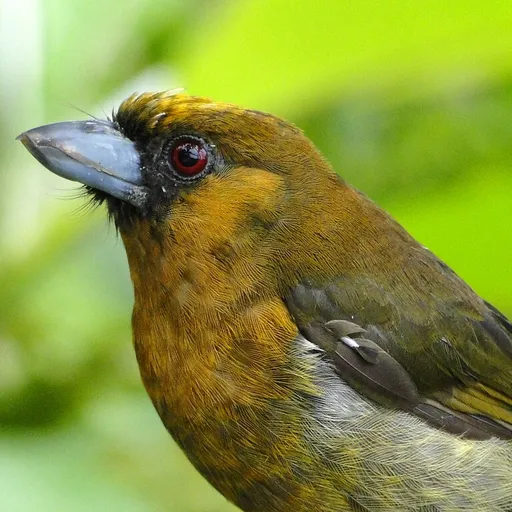
- Bill: Silvery gray to bluish with a dark, hooked tip that features a notch on the side, giving the species its name.
- Plumage: Dull golden brown crown, brownish olive nape, and olive green lower back; males possess a glossy black tuft at the rear of the crown, which females lack.
- Song: A resonant, far-carrying, throaty cwa-cwa-cwa-cwa, often performed in duet by both sexes.
Habitat
Found in the mountains from Costa Rica's Cordillera de Tilarán to western Panama's Veraguas Province, this non-migratory bird inhabits the interior and edges of extremely humid montane evergreen forest. The habitat is characterised by numerous epiphytes and mosses, with frequent fog and elevations typically ranging from 750 m to 2,450 m.
Diet
The species forages primarily in the forest canopy, often in flocks of up to 12 individuals during the non-breeding season. Its diet consists almost entirely of fruit, which is swallowed whole, squeezed to extract the interior, or torn apart if large, while insect larvae are fed to nestlings.
Did you know?
Despite being a barbet, the prong-billed barbet is more closely related to toucans than to Old World barbets, prompting its placement in its own family, Semnornithidae.
Sources
- Wikipedia · CC BY-SA 4.0
- Wikidata · CC0 1.0