
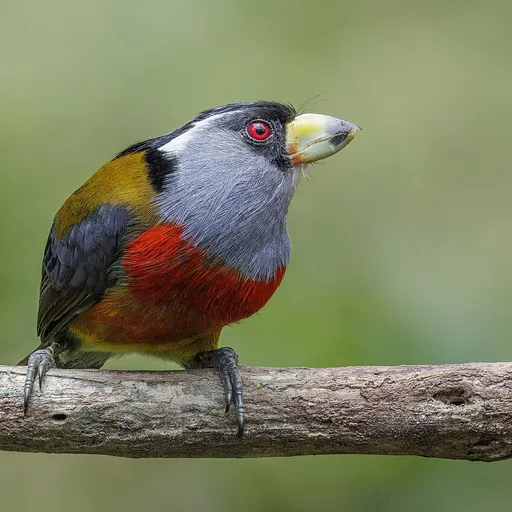
Toucan Barbet
Semnornis ramphastinus
Near Threatened
Listen
XC251539 · Niels Krabbe · Pichincha: Tandayapa ridge 3 km SSW Tandayapa, Ecuador · CC BY-SA 4.0
Overview
The toucan barbet, Semnornis ramphastinus, is a medium-sized barbet native to the humid montane forests of western Ecuador and Colombia. It forms the family Semnornithidae along with the prong-billed barbet and is closely related to toucans, having previously been classified with the barbets.
Identification
- Size: Medium-sized and robust, measuring 19 to 21 cm in length and weighing 80–115 g.
- Plumage: Striking colours including a black crown and mask, golden-brown nape, bright red lower breast and belly, yellowish-green lower belly, and grey wings and tail.
- Bill: Robust yellow maxilla and light green mandible with dark ends; the tip is pronged, though this feature is not easily noticed in the field.
- Behaviour: Often perches silently on long horizontal branches, but its loud, long-distance shrieks are unmistakable, typically performed in duet by breeding pairs.
Habitat
Native to the humid forests of the western Andes, ranging from northwest Ecuador to southwest Colombia at altitudes of 1,400–2,400 m. It occupies all levels of the forest, with a preference for the upper canopy and subcanopy, and is found in primary and secondary forests as well as forest edges.
Diet
Primarily frugivorous, consuming fruits from at least 62 species including Cecropia and Clusia, with fruit accounting for 54% of the nestling diet. The diet also includes insects, small reptiles, nectar, tree sap, and flower petals, with insect consumption increasing during certain seasons. It forages in small groups or mixed flocks across all levels of the forest.
Did you know?
The toucan barbet exhibits cooperative breeding behaviour, with helpers such as previous immature offspring aiding the dominant pair in incubation and raising young, significantly increasing reproductive success.
Sources
- Wikipedia · CC BY-SA 4.0
- Wikidata · CC0 1.0