
White-capped Tanager
Sericossypha albocristata
Vulnerable
Listen
XC251543 · Niels Krabbe · Zamora-Chinchipe: near Panguri, Ecuador · CC BY-SA 4.0
Overview
The white-capped tanager (Sericossypha albocristata) is a Vulnerable species of bird in the family Thraupidae, the tanagers and allies. It is found from Venezuela to Peru. The species was formally described in 1843 and is the only member of the genus Sericossypha.
Identification
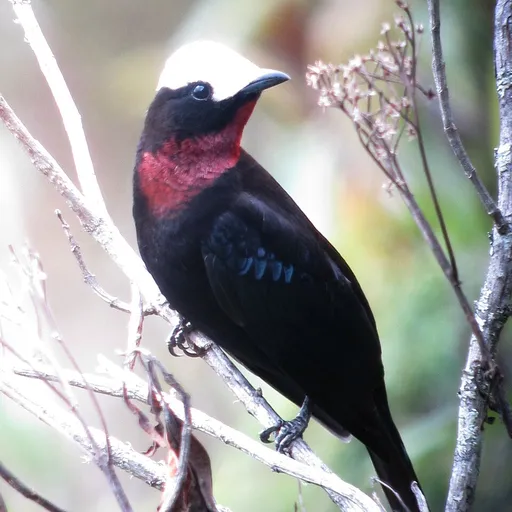
- Plumage: Adult males feature pure white lores, forehead, and crown with a plush texture, a mostly velvety black body, and a bright crimson throat and breast; wings and tail are glossy bluish black.
- Size: The heaviest member of its family, averaging 24 cm (9.4 in) in length and weighing 95 to 125 g (3.4 to 4.4 oz).
- Dimorphism: Adult females are less glossy with a duskier, almost purple throat and breast, while juveniles have a buffy gray crown and minimal red on the chin and upper throat.
- Vocalisation: Described as quite noisy with far-carrying jay-like calls, including an arresting "cheeeyáp!" followed by shrieking "cheeyp!" or "peeeyr!" calls.
Habitat
Inhabits the interior of humid montane forest heavy with mosses, occasionally on forest edges and secondary forest. The distribution is disjunct, found on the eastern slopes of the Andes from southern Táchira in Venezuela to Peru, and in Colombia in the upper Magdalena River valley and on both slopes of the Central Andes. Elevation ranges vary by country, generally between 1,700 and 3,300 m (5,600 and 10,800 ft).
Diet
The diet has not been formally studied, but stomach contents indicate consumption of larval and adult insects, seeds, fruit, and occasionally snails. Foraging is typically done in family groups of up to eight individuals, though flocks of up to 20 are known. It forages mostly in or near the forest canopy but may descend to the forest edge, and it has apparently large foraging ranges.
Did you know?
The species is believed to be a cooperative breeder, as a single known nest in Ecuador showed several adults provisioning a single well-feathered nestling. This is a significant behavioural trait that remains poorly documented, with almost no other information available on the species' breeding biology.
Sources
- Wikipedia · CC BY-SA 4.0
- Wikidata · CC0 1.0