
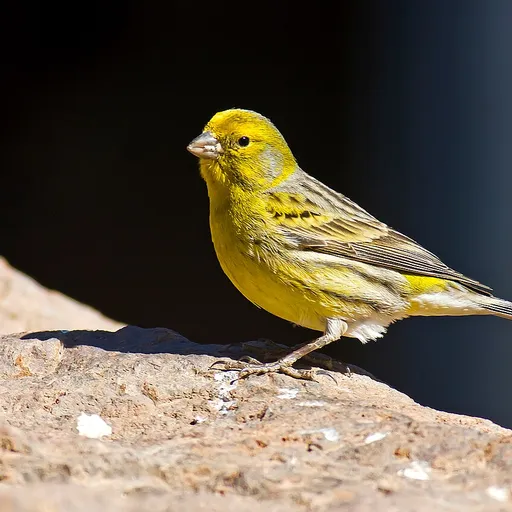
Atlantic Canary
Serinus canaria
Least Concern
Overview
The Atlantic canary, also known as the wild or island canary, is a small passerine bird native to the Canary Islands, the Azores, and Madeira. It is the natural symbol of the Canary Islands alongside the date palm and is common in captivity, where numerous colour varieties have been bred.
Identification
- Ranges from 10 to 12 cm in length with a wingspan of 21 to 23.7 cm.
- Males feature a largely yellow-green head and underparts with a yellower forehead and face, while females are duller with greyer plumage.
- Upperparts are grey-green with dark streaks and a dull yellow rump; juveniles are largely brown with dark streaks.
- The song is described as a silvery twittering.
Habitat
Endemic to the Macaronesia region of the eastern Atlantic Ocean, specifically the Canary Islands, Azores, and Madeira. It inhabits a wide variety of environments, from pine and laurel forests to sand dunes, but is most common in semi-open areas with small trees such as orchards, copses, parks, and gardens.
Diet
Typically feeds in flocks on the ground or amongst low vegetation, primarily consuming seeds from weeds, grasses, and figs. It also consumes other plant material and small insects.
Did you know?
The colour canary yellow is named after the domestic canary, which was produced by a mutation that suppressed the melanins of the original dull greenish wild plumage.
Sources
- Wikipedia · CC BY-SA 4.0
- Wikidata · CC0 1.0