
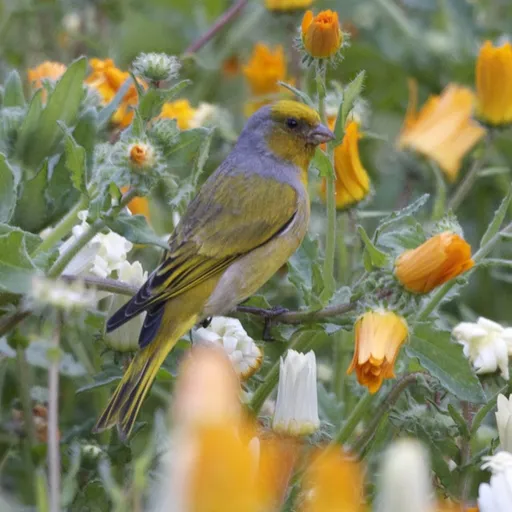
Cape Canary
Serinus canicollis
Least Concern
Overview
The Cape canary (Serinus canicollis) is a small passerine bird in the finch family, native to southern Africa and introduced to Mauritius and Réunion. It is a common, gregarious species that remains resident in its range but exhibits seasonal altitudinal movements, often forming large flocks outside the breeding season.
Identification
- Adults measure 11–13 cm, with males featuring a green back, yellow underparts and rump, white lower belly, grey rear head and neck, and a cinnamon face.
- Females resemble males but have less grey on the head, while juveniles display greenish-yellow underparts with heavy brown streaking.
- Distinguished from the yellow-fronted canary by the absence of black face markings.
- The call is described as 'tsit-it-it', accompanied by warbled, goldfinch-like trills and whistles during display flight or from high perches.
Habitat
The species inhabits a variety of terrestrial environments, including fynbos, grassland, gardens, and the edges or clearings of lowland and lower montane forests. It is found at altitudes ranging from 2,000 to 3,000 metres, preferring highland areas such as those with African juniper and Podocarpus trees. Its range extends across southern Africa, with specific subspecies distributed in Zimbabwe, Mozambique, South Africa, Lesotho, and Eswatini.
Diet
This gregarious seed-eater primarily feeds on soft green seeds, foraging among low vegetation within reach of flowers and shrubs. It takes seeds directly from the ground or flower heads, usually in pairs or flocks of up to 50 birds during the breeding season. Outside the breeding season, it joins larger mixed flocks of up to 500 birds to forage.
Did you know?
The male performs a courtship display involving a slow flight while singing loudly, followed by swooping to chase the female, which responds by becoming droop-winged. The nest is constructed by the female using a mix of roots, plant fluff, moss, hair, and feathers, and can be placed as high as 20 metres up in a tree or vine.
Sources
- Wikipedia · CC BY-SA 4.0
- Wikidata · CC0 1.0