
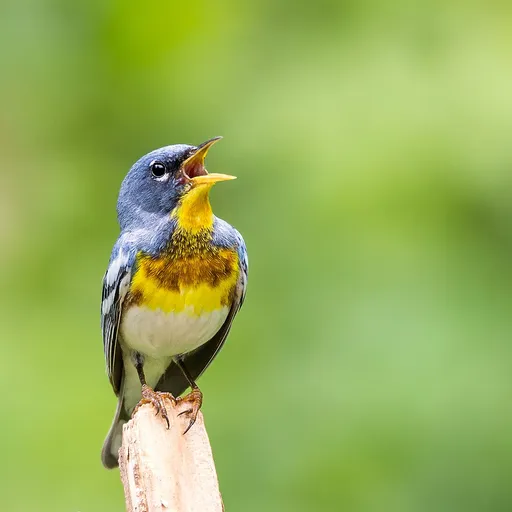
Northern Parula
Setophaga americana
Least Concern
Overview
The northern parula (Setophaga americana) is a small New World warbler that is currently classified as Least Concern by the IUCN. It is a migratory species that breeds across eastern North America, extending from southern Canada to Florida.
Identification
- Length ranges from 10.8 to 12.4 cm, making it one of the smallest North American migratory warblers.
- Upper parts are mainly blue-grey with a greenish back patch and two white wing bars; the breast is yellowish, shading into a white belly.
- Summer males display bluish and rufous breast bands along with prominent white eye crescents, while females are duller and typically lack the breast bands.
- The song consists of a click-like trill or buzz described as 'zeeeee-yip', accompanied by a soft chip call.
Habitat
This primarily forest-dwelling species prefers habitats with increased tree species diversity, canopy height, and canopy cover. Northern populations breed in mature, moist coniferous forests such as spruce bogs or hemlock swamps, whereas southern populations favour mature, moist bottomland forests where Spanish moss is prevalent. Outside the breeding season, it becomes a habitat generalist, inhabiting shrubby pastures, various forest types, and agricultural fields during migration and winter.
Diet
The northern parula forages mostly or entirely on arboreal invertebrates, including spiders, damselflies, locusts, bugs, grasshoppers, aphids, beetles, caterpillars, flies, wasps, bees, and ants. It primarily captures prey using a hover-glean method but also employs short flights from perches to snatch prey mid-air or hangs upside down to forage. During winter, its diet shifts to include more beetles and occasionally berries, seeds, and nectar.
Did you know?
Northern parulas will occasionally hybridize with yellow-throated warblers, resulting in a hybrid species known as Sutton's warblers. The genus name Setophaga is derived from the Ancient Greek words for 'moth' and 'eating'.
Sources
- Wikipedia · CC BY-SA 4.0
- Wikidata · CC0 1.0