
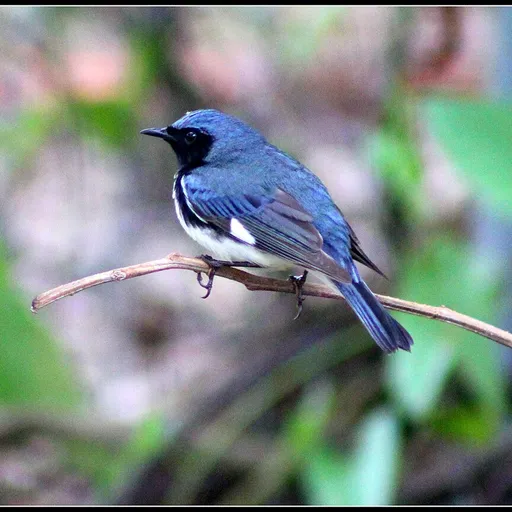
Black-throated Blue Warbler
Setophaga caerulescens
Least Concern
Listen
XC311813 · Tom Austin · Clemson University/SCDNR--Cherry Farm, Pickens County, South Carolina, United States · CC BY-SA 4.0
Overview
The black-throated blue warbler (Setophaga caerulescens) is a small passerine bird belonging to the New World warbler family. It is a migratory species that breeds in temperate forests of eastern North America and overwinters in the Caribbean and Central America. Although its overall population is estimated at 2.4 million individuals and it is classified as Least Concern, its numbers are locally declining due to deforestation and habitat fragmentation.
Identification
- Adult males feature deep blue upperparts, white underparts, and a black face, throat, and flanks.
- Adult females display olive-brown upperparts, light yellow underparts, a grey crown, and brown cheek patches.
- Both sexes possess a thin, pointed bill and small white wing patches that are not always visible.
- The song is a buzzed zee-zee-zeeee with an upward inflection, accompanied by a flat ctuk call.
Habitat
This species breeds in temperate mature deciduous or mixed coniferous-deciduous forests with a thick understory, typically in hilly and mountainous regions of the northeastern United States and southeastern Canada. It migrates to tropical wooded and scrub habitats in the Greater Antilles for the winter, occasionally appearing in parks and gardens along the migration route.
Diet
Predominantly insectivorous, this warbler forages actively in low vegetation and the understory, often hovering or catching insects in flight. It consumes invertebrates such as caterpillars, crane flies, and spiders, while supplementing its diet with seeds, berries, and fruit during winter.
Did you know?
Although socially monogamous, extra-pair fertilisations are common, with the majority of extra-pair sires coming from males in neighbouring territories. Females may engage in this behaviour to incorporate better genes, specifically the MHC locus, to improve the immunocompetence of their offspring.
Sources
- Wikipedia · CC BY-SA 4.0
- Wikidata · CC0 1.0