
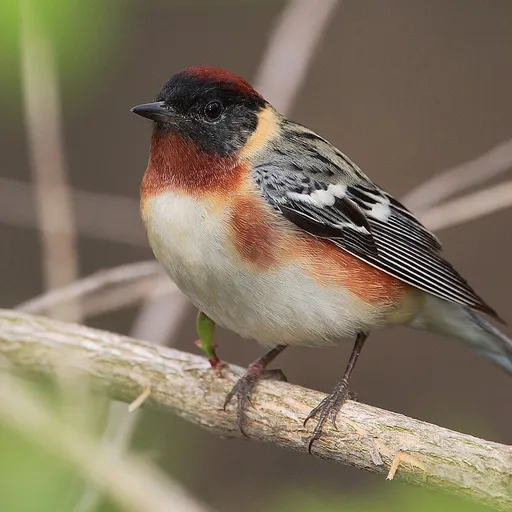
Bay-breasted Warbler
Setophaga castanea
Least Concern
Listen
XC1103938 · Doug Hynes · Qame'k (Seal Island), Kespukwitk, Nova Scotia, Canada · CC BY-SA 4.0
Overview
The bay-breasted warbler (Setophaga castanea) is a small species of songbird in the New World warbler family, Parulidae. It is classified by the IUCN as Least Concern, although the species has historically experienced a slow decline due to loss of insect prey and global climate change.
Identification
- Breeding males are primarily greyish above with two white wing bars, dark back streaks, and a creamy neck patch.
- The face is black, while the crown, throat, and sides are a dark chestnut colour.
- Breeding females are similar to males but paler and duller, with rufous flanks that may fade entirely in non-breeding seasons.
- Feet are black, distinguishing the species from similar birds like the blackpoll warbler which have yellowish feet.
Habitat
Breeding occurs in the boreal spruce-fir forests of eastern and central Canada, as well as the far northeast of the United States. Wintering grounds are found in the wet lowland forests of northeastern South America, the Caribbean, and southern Central America. Migration passes through the eastern half of the United States, with many individuals crossing the Gulf of Mexico.
Diet
During the breeding season, the species feeds primarily on insects and spiders, especially the spruce budworm, by gleaning them from vegetation. On wintering grounds in the tropics, fruit constitutes the majority of the diet. Foraging is concentrated in the interior middle portions of coniferous trees to avoid competition, and wintering individuals often join mixed-species flocks.
Did you know?
In wintering mixed-species flocks, the bay-breasted warbler is often an aggressive member, bullying smaller species away from potential food sources. Some individuals have been recorded as rare vagrants in Greenland and on the west coast of North America.
Sources
- Wikipedia · CC BY-SA 4.0
- Wikidata · CC0 1.0