
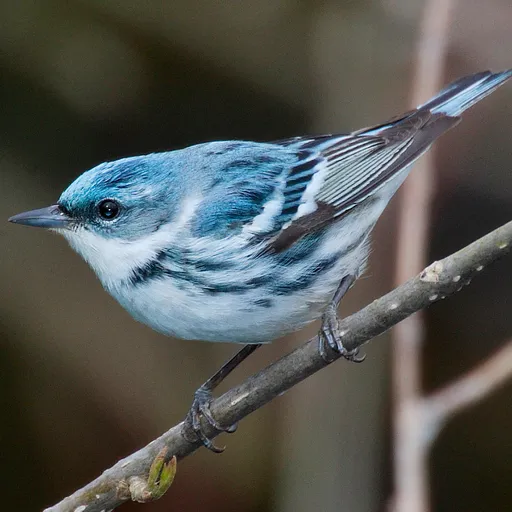
Cerulean Warbler
Setophaga cerulea
Near Threatened
Overview
The cerulean warbler (Setophaga cerulea) is a small songbird in the family Parulidae that migrates long distances between eastern North America and South America. Classified as Near Threatened by the IUCN, it is the fastest declining Neotropical migrant songbird, facing significant risks from habitat loss in its wintering range.
Identification
- One of the smallest Setophaga wood-warblers, measuring about 11 cm in length with a 20 cm wingspan.
- Adult males feature cerulean blue upperparts, white underparts, and a distinct black necklace across the breast, while females are yellow below with bluish-green upperparts and a pale eye stripe.
- All individuals possess two white wing bars, white tail spots, and a thin, pointed bill.
- The song consists of a buzzed, accelerating 'zray zray zray zray zeeee', and the primary call is a metallic 'zzee'.
Habitat
In the breeding season, it inhabits large, unfragmented mature deciduous hardwood forests in eastern North America, preferring the top canopy above 30 m in height. During the non-breeding season, it resides in the Eastern slope of the Andes in South America, favouring old-growth subtropical forests, shade coffee plantations, and altitudes between 500 and 2,000 m.
Diet
The cerulean warbler is insectivorous, primarily gleaning lepidopteran larvae such as butterfly and moth caterpillars from leaves and twigs in the mid to high forest canopy. It also consumes winged insects and, in its non-breeding range, may forage on flowers and prefer trees of the genus Inga.
Did you know?
The genus name Setophaga is derived from Greek roots meaning 'moth eating', reflecting the bird's strong preference for caterpillars. Its population in 2006 was less than one-fifth of what it was just 40 years prior.
Sources
- Wikipedia · CC BY-SA 4.0
- Wikidata · CC0 1.0