
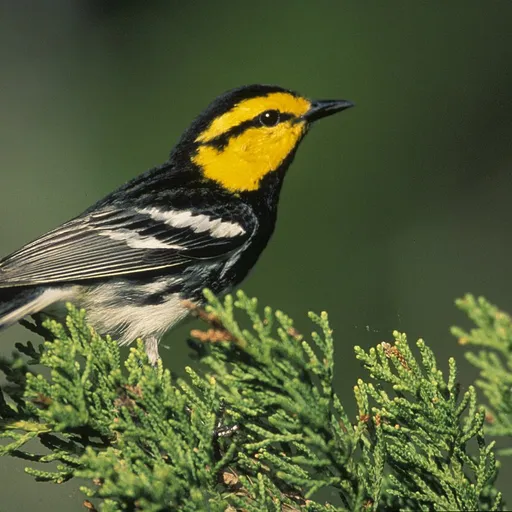
Golden-cheeked Warbler
Setophaga chrysoparia
Endangered
Overview
The golden-cheeked warbler (Setophaga chrysoparia) is an endangered species of bird that breeds exclusively in Central Texas. It is unique among bird species as the only one with a breeding range endemic to a single US state, specifically the eastern and southern edge of the Edwards Plateau.
Identification
- Bright yellow cheeks contrasted by a black throat and back.
- Identified in the field by its unique buzzing song emerging from wooded canyons.
- Males produce 'chip' sounds used for courtship and as a warning call during times of danger.
Habitat
The species occupies juniper-oak woodlands in central and southern Texas, ranging from moist areas with tall, closed canopies of ashe juniper and oak trees to drier uplands on flat topography. During the winter months, the bird migrates to short-lived evergreen forests with pines in Mexico, Guatemala, Nicaragua, and Honduras, situated at elevations between 3,300 and 8,300 feet.
Diet
This species is completely insectivorous, feeding on various forms of insects, spiders, and caterpillars, with the latter being a primary food source during the breeding season. Foraging involves gleaning insects from foliage and branches, as well as sallying from branch edges to snatch insects in flight.
Did you know?
The bird is entirely dependent on ashe juniper trees for nesting material, as females will not build a nest without the presence of fine juniper bark strips. The species was featured on a United States Postal Service Forever stamp in 2023 and appeared on the livery of a Frontier Airlines Airbus 321 in 2024.
Sources
- Wikipedia · CC BY-SA 4.0
- Wikidata · CC0 1.0