
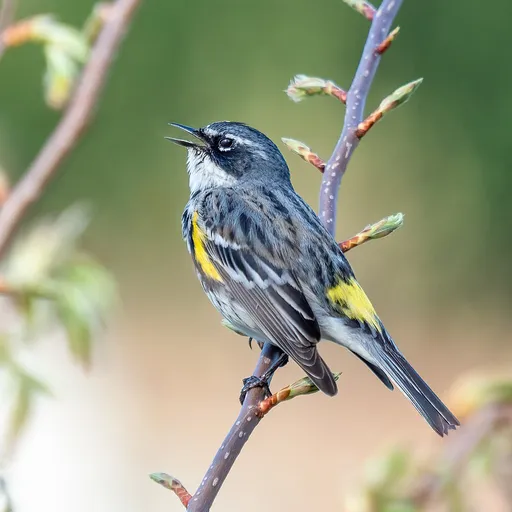
Myrtle Warbler
Setophaga coronata
Least Concern
Listen
XC570786 · Doug Hynes · Goulds, Newfoundland and Labrador, Canada · CC BY-SA 4.0
Overview
The myrtle warbler, scientifically known as Setophaga coronata, is a North American bird species that is commonly observed across the continent. It connects the Pacific and Atlantic coasts of the United States as well as Canada and Central America, with populations concentrated in the northern reaches during the breeding season. This species is classified as Least Concern on the IUCN Red List.
Identification
- Adult males display gray backs with dark streaks, black cheeks, and a white throat and eye stripe, while females feature brown backs and brown or gray cheeks.
- All subspecies possess conspicuous yellow patches on the rump, often earning the bird the nickname "butter butt" among birdwatchers.
- The average length ranges from 12 to 15 cm, with a wingspan of 19 to 24 cm and a body mass between 9.9 and 17.7 g.
- Its song consists of a trill-like 4–7 syllable sequence described as "tyew-tyew-tyew-tyew" or "tew-tew-tew", accompanied by occasional check or chip call notes.
Habitat
During the breeding season, the species generally resides in exclusively coniferous areas or mixed coniferous-deciduous habitats, such as those containing aspen and willow trees. In winter, it inhabits open areas with shrubs or scattered trees, including agricultural zones, residential areas, and shrublands that provide food resources. The breeding range extends from Alaska across Canada to Newfoundland, while wintering grounds include southern British Columbia, Panama, and most of the southeastern United States.
Diet
Primarily insectivorous, this species is noted for its versatile foraging methods, including gleaning from leaves and flycatcher-like sallying out from perches to catch flying insects. When insects are scarce, it consumes fruits such as wax-myrtle berries, juniper berries, and grapes, as well as wild seeds from beach grasses and goldenrod. It is the only warbler capable of digesting waxy material like wax-myrtle berries, which allows it to winter farther north than other warbler species.
Did you know?
The myrtle warbler is the only warbler able to digest waxy materials such as wax-myrtle berries, an adaptation that enables it to winter significantly farther north than its peers, sometimes as far north as Newfoundland. Males tend to forage higher in the trees than females and will aggressively displace other warbler species, including pine warblers and Blackburnian warblers, when sharing a foraging site.
Sources
- Wikipedia · CC BY-SA 4.0
- Wikidata · CC0 1.0