
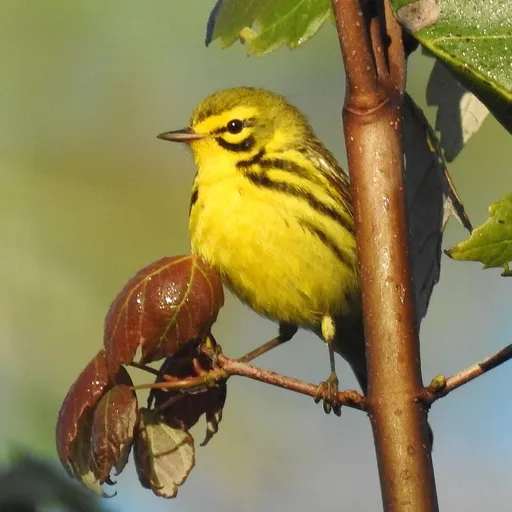
Prairie Warbler
Setophaga discolor
Least Concern
Overview
The prairie warbler (Setophaga discolor) is a small songbird of the New World warbler family. Although the name suggests an open habitat, the species generally prefers shrubbery and small trees.
Identification
- Yellow underparts with dark streaks on the flanks.
- Males feature an olive-green back with chestnut or rufous streaks, while females and immatures are duller with fainter markings.
- A black stripe through the eye and another from the beak down the throat create a distinctive 'tired' look.
- Birds have two faint wing bars, large white areas on the tails, and dark legs.
Habitat
Breeding habitats consist of brushy areas and forest edges in eastern North America, with the highest population density in the southeast. The migratory subspecies winters in southern Florida, the West Indies, and the eastern coast of Mexico and Central America, while the sedentary subspecies inhabits the coasts of Florida year-round.
Diet
Prairie warblers forage primarily for insects, usually by gleaning from twigs, leaves, and infrequently trunks and branches. Less common tactics include fly-catching, hovering, and chasing, though they have rarely been observed pecking the ground, feeding on nectar, and web-picking.
Did you know?
Prairie warblers frequently wag or pump their tails, a behaviour they share with Palm warblers and Kirtland's warblers.
Sources
- Wikipedia · CC BY-SA 4.0
- Wikidata · CC0 1.0