
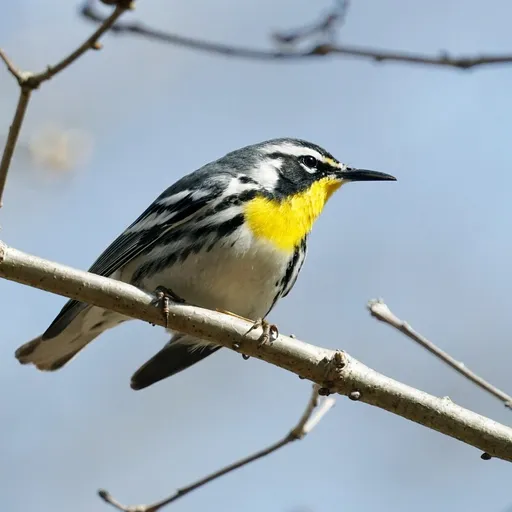
Yellow-throated Warbler
Setophaga dominica
Least Concern
Listen
XC884289 · steve · Chapel Hill, Orange County, North Carolina, United States · CC BY-SA 4.0
Overview
The yellow-throated warbler (Setophaga dominica) is a small migratory songbird in the New World warbler family Parulidae. It is primarily found in temperate North America, with one southern subspecies being resident rather than migratory.
Identification
- Size and build: 13–14 cm long with a 21 cm wingspan, weighing 8.5–11.3 g.
- Plumage: Males have gray upperparts with double white wing bars, a yellow throat, and white underparts streaked with black on the flanks; the head features strong black-and-white patterns including a long supercilium.
- Variation: Females, immatures, and non-breeding males resemble washed-out summer males with less crisp head patterns and duller yellow hues.
- Vocalisation: Males sing clear, descending whistles, while calls consist of high sees or sharp chips.
Habitat
Breeding occurs in southeastern North America, ranging from southern Pennsylvania and northern Missouri to the Gulf of Mexico. The bird favours woodland habitats with a preference for coniferous or swamp tree species. Most populations migrate to winter in the Gulf Coast, eastern Central America, and the Caribbean, though a Florida subspecies remains resident year-round.
Diet
Primarily insectivorous, but berries and nectar make up a considerable part of the diet outside the breeding season. Foraging involves picking food directly from tree branches or hovering briefly to catch flying insects, with occasional captures of anoles.
Did you know?
Yellow-throated warblers occasionally hybridise with northern parulas to produce a hybrid known as 'Sutton's warbler', which lacks the black breast streaks and greenish-yellow back wash typical of its parent species.
Sources
- Wikipedia · CC BY-SA 4.0
- Wikidata · CC0 1.0