
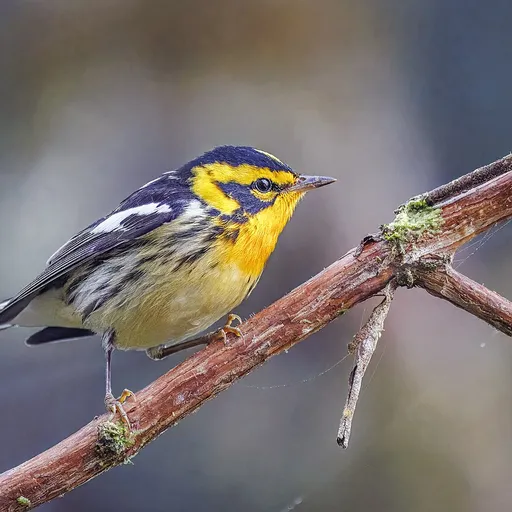
Blackburnian Warbler
Setophaga fusca
Least Concern
Listen
XC1070418 · Rosa Elena Albornoz @rosaelena_naturaleza · San Antonio De Los Altos (near Parroquia Macarao), Municipio Los Salias, Miranda, Venezuela · CC0 1.0
Overview
The Blackburnian warbler (Setophaga fusca) is a small New World warbler that breeds across eastern North America and winters in South America. It is classified as Least Concern on the IUCN Red List.
Identification
- Size: Small passerine, 11 to 13 cm long, weighing 8 to 13 g.
- Plumage: Summer males feature dark gray backs, yellowish rumps, white underparts with black streaks, a strongly patterned yellow and black head, and a flaming-orange throat, a combination unique among North American warblers.
- Other Plumes: Females and non-breeding males are duller with weaker yellows and grays, but retain a distinctive dull-yellow supercilium contrasting with greyish cheeks and yellow throat.
- Song: A high-pitched series of 'swi' notes that often ascend, transliterated as 'zip zip zip' or 'teetsa teetsa'.
Habitat
Breeding occurs in mature coniferous woodlands, particularly spruce and hemlocks, across the southeastern boreal forest of Canada, the Great Lakes region, and the Appalachian Mountains down to northernmost Georgia. During winter, the species inhabits tropical montane forests between 600 and 2,500 meters in elevation, mainly from Colombia to Peru.
Diet
Primarily insectivorous, foraging for insects and spiders in the top canopy of trees; during the breeding season, the diet consists mainly of Lepidoptera larvae. In winter, berries are added to the diet.
Did you know?
The Blackburnian warbler is the only North American warbler with a flaming-orange throat.
Sources
- Wikipedia · CC BY-SA 4.0
- Wikidata · CC0 1.0