
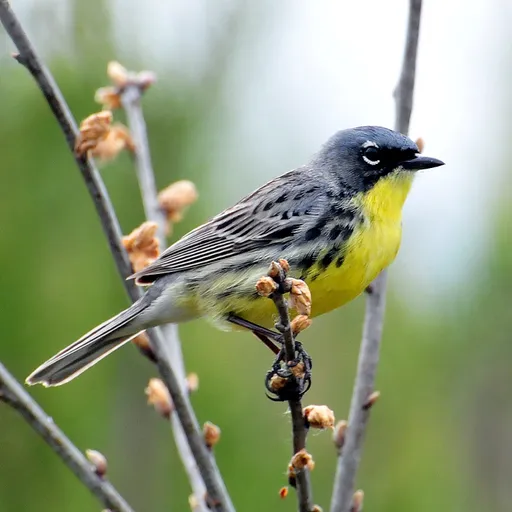
Kirtland's Warbler
Setophaga kirtlandii
Near Threatened
Overview
Kirtland's warbler (Setophaga kirtlandii), also known as the jack pine bird, is a small songbird of the New World warbler family. It is the largest of the approximately 35 species currently accepted in the genus Setophaga.
Identification
- Males possess bluish-grey upperparts with dark back streaks, yellow bellies, dark flanks, black lores and a large broken white eye-ring; females and juveniles are browner and less boldly marked.
- At 14–15 cm in length, it is the largest member of its genus, with a wingspan of 22 cm.
- The mating song is a loud chip-chip-chip-too-too-weet-weet, often sung from the top of a snag, which can be heard over 400 m away in good conditions.
- In wintering grounds the bird is silent except for loud 'chip' noises and frequently bobs its tail up and down, a movement uncommon in northern warblers.
Habitat
The species requires large areas of dense, young jack pine forest, typically 4–25 years old, for breeding, and spends its winters in the West Indies, primarily in low coppice habitat that has regrown after abandoned slash-and-burn agriculture. Its breeding range is in the Great Lakes region of Canada and the United States, while it overwinters in Cuba, The Bahamas, the Turks and Caicos Islands and Hispaniola.
Diet
During the summer, the warbler feeds on blueberries and insects such as spittlebugs, aphids and ants. In its overwintering range it depends heavily on the berries of Lantana involucrata, as well as Erithalis fruticosa and Chiococca alba.
Did you know?
The bird was first recorded by Europeans relatively late for a species from eastern North America, with the first specimen being shot at sea between The Bahamas and Cuba in 1841 and remaining unrecognised as a new species until the 1860s. Its generic name Setophaga derives from Ancient Greek meaning 'moth-eating'.
Sources
- Wikipedia · CC BY-SA 4.0
- Wikidata · CC0 1.0