
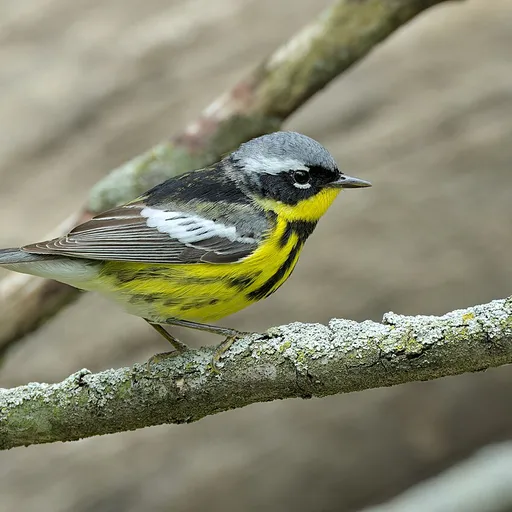
Magnolia Warbler
Setophaga magnolia
Least Concern
Listen
XC993115 · Doug Hynes · Sheep Island, Nova Scotia, Canada · CC BY-SA 4.0
Overview
The magnolia warbler (Setophaga magnolia) is a moderately small New World warbler belonging to the family Parulidae. It is a widespread and common species assessed as Least Concern on the IUCN Red List, with a typical lifespan of up to seven years.
Identification
- Measures 11 to 13 cm in length with a wing span of 16 to 20 cm and a body mass ranging from 6.6 to 12.6 g.
- Breeding males feature white, gray, and black backs with yellow flanks, and distinctive yellow and black-striped stomachs that help distinguish them from similar species like the prairie warbler.
- Possesses white patches on the wings known as wing bars, and a black tail with white stripes on the underside.
- Females and immature birds resemble the male plumage but with significantly duller colours.
Habitat
Breeds in dense, young coniferous forests across northern Great Lakes, New England, the Appalachian regions, and central and eastern Canada. Winters in southern Mexico, Central America, and the Caribbean, migrating through eastern and central United States, including areas as far west as Oklahoma and Kansas.
Diet
Primarily consumes arthropods, with a strong preference for caterpillars, as well as beetles, butterflies, and spiders. During the breeding season, it also eats fruit and parts of coniferous branches, while increasing its intake of fruit and nectar during the winter.
Did you know?
Females consume the fecal sacs of their newborn chicks to maintain nest cleanliness, a behaviour that shifts to simple removal by both parents as the chicks mature. Rare hybrids between the magnolia warbler and the American redstart have been documented, consistently with the magnolia warbler as the mother and the redstart as the father.
Sources
- Wikipedia · CC BY-SA 4.0
- Wikidata · CC0 1.0