
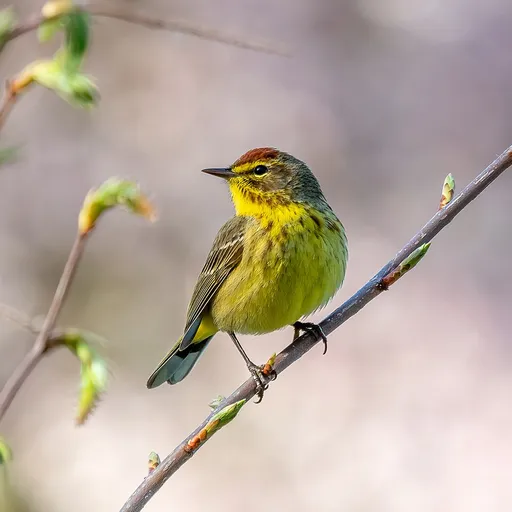
Palm Warbler
Setophaga palmarum
Least Concern
Listen
XC1102779 · Doug Hynes · Wolfes Island, Nova Scotia, Canada · CC BY-SA 4.0
Overview
The palm warbler (Setophaga palmarum) is a small songbird in the New World warbler family. It is classified as Least Concern on the IUCN Red List.
Identification
- Length of 12–14 cm with a wingspan of 20–21 cm and a weight between 8.5 and 14.2 g.
- The eastern subspecies features brownish-olive upper parts and thoroughly yellow underparts with bold rufous streaking, while the western subspecies is colder grayish-brown with less yellow and streaking.
- Produces a monotonous buzzy trill as its song and a sharp 'chek' call.
- Exhibits a constant, incessant tail-bobbing movement while foraging.
Habitat
Breeds in open coniferous bogs and edge east of the Continental Divide across Canada and the northeastern United States. Winter ranges include the southeastern United States, the Yucatán Peninsula, Caribbean islands, and eastern Nicaragua to Panama. It also utilises shrublands, forests, grasslands, wetlands, and human-modified environments.
Diet
Forages on the ground more frequently than other warblers and may fly to catch insects. Its diet consists mainly of insects and berries.
Did you know?
The palm warbler is one of the earliest migrants to return to its breeding grounds, often arriving nearly two months before most other warblers.
Sources
- Wikipedia · CC BY-SA 4.0
- Wikidata · CC0 1.0