
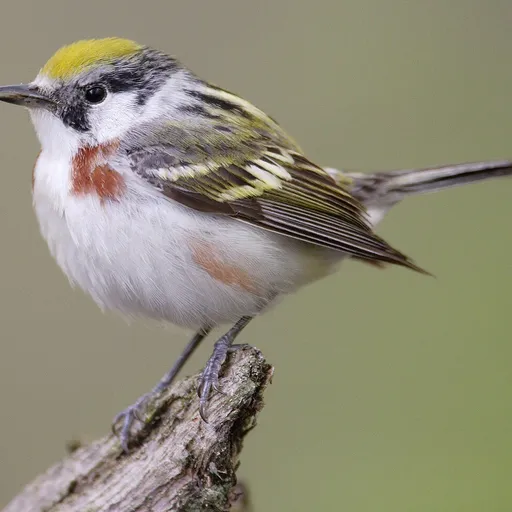
Chestnut-sided Warbler
Setophaga pensylvanica
Least Concern
Listen
XC797241 · steve · Zionville, Watauga County, North Carolina, United States · CC BY-SA 4.0
Overview
The Setophaga pensylvanica is a moderately sized New World warbler that breeds across eastern North America and winters in Central America and northern South America. Although classified as Least Concern on the IUCN Red List, its population has fluctuated with changes in forest habitat, increasing when second-growth woodland became prevalent but declining slightly in recent decades.
Identification
- Summer males display dark-streaked grey backs, white faces with black eyestripes, yellow crowns, white underparts with chestnut flanks, and two white wing bars.
- Females resemble washed-out summer males, lacking strong head patterns and having little to no chestnut on the flanks, while non-breeding birds of both sexes have bright yellow-green crowns, white eye-rings, and unstreaked underparts.
- The species measures 10 to 14 cm in length with a wingspan of 16 to 21 cm and a body weight between 8 and 13.1 g.
- Song consists of high whistled lines described as "pleased, pleased, pleased to MEECHA", with the accented version used for courtship and unaccented versions for aggression, while calls are harsh chips.
Habitat
Breeding populations are found in eastern North America, extending from Saskatchewan to the Maritimes, where the species favours second-growth habitats, forests after clear-cutting, or burn sites. During the non-breeding season, they inhabit mature tropical rainforests in Central America and northern Colombia, often utilising coffee plantations and riparian zones in the canopy layers.
Diet
Primarily insectivorous, this warbler feeds on lepidopteran and dipteran larvae, and occasionally consumes spiders, seeds, and fruits. Foraging is typically done alone by gleaning insects from the foliage of shrubs and small trees, or by hawking insects in mid-air, with berries forming a significant part of their winter diet.
Did you know?
A three-species hybrid named Burket's warbler, documented in Pennsylvania in 2018, was confirmed to have a chestnut-sided warbler as its father and a Brewster's warbler as its mother. Additionally, males that sing only unaccented songs are significantly less successful at securing mates than those that use the accented courtship call.
Sources
- Wikipedia · CC BY-SA 4.0
- Wikidata · CC0 1.0