
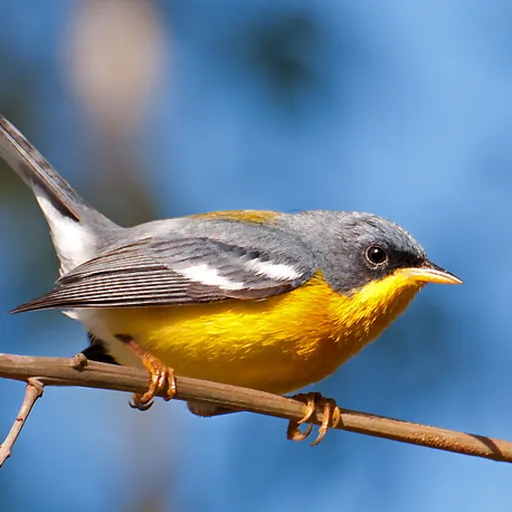
Tropical Parula
Setophaga pitiayumi
Least Concern
Listen
XC912262 · JUAN ANTONIO ALONSO DE JUAN · Vereda La Máquina, Pacho, Cundinamarca, Colombia · CC BY 4.0
Overview
The tropical parula (Setophaga pitiayumi) is a passerine bird in the family Parulidae, commonly known as a New World warbler. It is classified as a species of Least Concern by the IUCN Red List due to its extensive range across the Americas, although its population is estimated to be decreasing.
Identification
- Approximately 11 cm in length and weighing 6.5 to 8.0 g, with blue-gray upperparts and yellow underparts washed with orange in males.
- Features two white wing bars on blue-gray wings and large white spots on the tail feathers.
- Possesses a black or brownish maxilla with a yellow mandible and light pinkish-brown legs.
- Males sing a rising trill or a complex flow of notes, while both sexes give sharp high-pitched calls described as 'pit', 'sip', 'chik', or 'tip'.
Habitat
Found throughout the Americas from Texas and Mexico to South America, as well as on Trinidad and the Falkland Islands, though absent from the Amazon Basin. It inhabits semi-arid to humid landscapes, primarily forested and somewhat open areas such as woodlands, gallery forests, and forest edges, while shunning very humid lowland tropical evergreen forest. In Texas, it is almost always found in taller woodland heavy with epiphytes like Tillandsia 'mosses'.
Diet
Feeds mostly on larval and adult insects, but also consumes other arthropods, berries, and the sweet excretions of plant lice. It typically forages by gleaning from foliage, though it has been observed catching winged termites in mid-air. During the breeding season, it forages in the sub-canopy and canopy, often singly or in pairs, while in the non-breeding season it frequently joins mixed-species feeding flocks in the understory.
Did you know?
Nests are typically constructed as domes hollowed out within epiphytes and lined with fine plant fibers and hair. These nests can be found at heights ranging from 2 to 13 m above the ground.
Sources
- Wikipedia · CC BY-SA 4.0
- Wikidata · CC0 1.0