
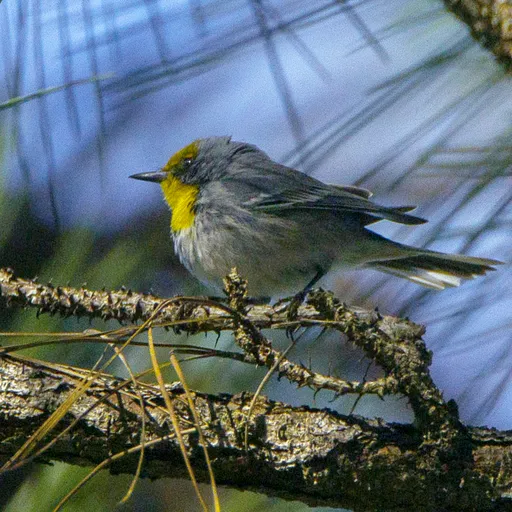
Olive-capped Warbler
Setophaga pityophila
Least Concern
Overview
The olive-capped warbler (Setophaga pityophila) is a species of New World warbler found in specific regions of Cuba and the Bahamas. It is a sedentary, year-round resident that inhabits pine forests and is assessed as Least Concern by the IUCN.
Identification
- Length of 12.5 to 13 cm with a weight of 7.2 to 8.7 g.
- Yellowish olive crown and slate-gray to plumbeous upperparts.
- Slate-gray face with black lores and a thin yellow line above the lores extending to the top of the eye.
- Yellow throat and breast with irregular black streaks, white belly, and two white wing bars.
- Song consists of high, melodious, whistle-like notes, generally 8 quick 'wisi-wisi-wisi' sounds, and a 'tsip' call.
Habitat
Found in two areas of Cuba, Pinar del Río Province in the west and Holguín, Santiago de Cuba, and Guantánamo provinces in the east, as well as on Grand Bahama, Little Abaco, and Great Abaco in the Bahamas. It almost exclusively inhabits pine forest, occasionally occurring in adjacent mixed pine-hardwood forest. Its elevation range extends from sea level to 2,000 m.
Diet
The diet has not been studied but is assumed to consist mostly of insects and other arthropods. In the Bahamas, it has been observed at the flowers of century plants, though it is unknown if they were seeking insects or nectar.
Did you know?
Though the IUCN lists the Turks and Caicos Islands as part of its range, no other source includes this archipelago. Its population is believed to be decreasing, yet no immediate threats have been identified.
Sources
- Wikipedia · CC BY-SA 4.0
- Wikidata · CC0 1.0