
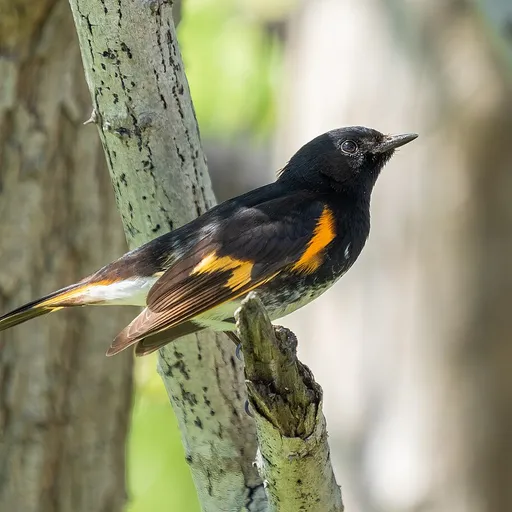
American Redstart
Setophaga ruticilla
Least Concern
Listen
XC797240 · steve · Zionville, Watauga County, North Carolina, United States · CC BY-SA 4.0
Overview
The American redstart (Setophaga ruticilla) is a smallish New World warbler that is classified as Least Concern on the IUCN Red List. It is one of the lightest birds in its family, with weight fluctuating significantly between summer and winter plumages. Although distantly related to the Old World redstart, both species belong to the order Passeriformes.
Identification
- Breeding males are jet black above with large orange-red patches on the wings and tail, while their underparts are white with orange sides.
- Females and young birds display green upperparts, black central tails, and grey heads, with yellow patches replacing the male's orange.
- The bird measures 11 to 14 cm in length with a relatively long tail, and is characterised by a small bill and short tarsus.
- Its song consists of a series of musical see notes, accompanied by a soft chip call.
Habitat
Breeding occurs in open-canopy, mostly deciduous forests, second growth, and forest edges across southern Canada and the eastern United States. The species winters in Central America, the West Indies, and northern South America, where it occupies nearly all woody habitats but tends to avoid non-forested agricultural areas. It is also a rare vagrant to western Europe.
Diet
The American redstart is insectivorous, feeding almost exclusively on insects such as caterpillars, moths, flies, and beetles, which are usually caught by flycatching or gleaning from leaves. It occasionally consumes a few berries and seeds from barberry, serviceberry, and magnolia. This species is a very active and flexible feeder that forages in the mid to lower regions of trees and shrubs.
Did you know?
The bird's name 'redstart' is derived from the old word 'start' for tail, referring to the male's red tail. It has been observed flashing the orange and yellow of its tail on and off to startle and chase insects from the underbrush.
Sources
- Wikipedia · CC BY-SA 4.0
- Wikidata · CC0 1.0