
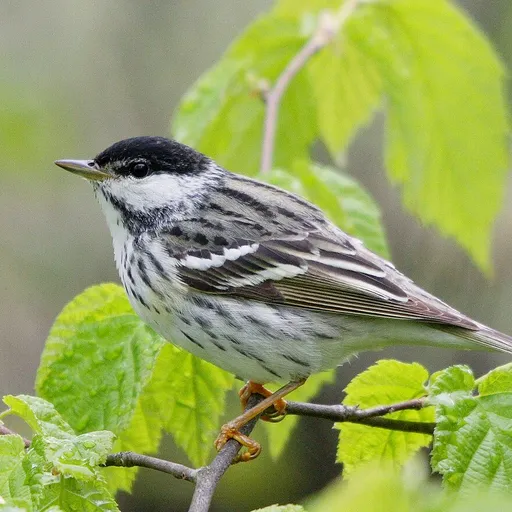
Blackpoll Warbler
Setophaga striata
Near Threatened
Listen
XC1047424 · Rosa Elena Albornoz @rosaelena_naturaleza · San Antonio De Los Altos (near Parroquia Macarao), Los Salias, Miranda, Venezuela · CC0 1.0
Overview
The blackpoll warbler (Setophaga striata) is a New World warbler found across North America. It is classified as Near Threatened by the IUCN Red List and is notable for undertaking one of the longest non-stop over-water migrations of any songbird.
Identification
- Breeding males feature dark-streaked brown backs, white faces, black crowns, and two white wing bars, while females resemble washed-out versions of the males with greyer heads.
- Non-breeding individuals display greenish heads, dark-streaked greenish upperparts, and yellowish breasts.
- The species is characterised by bright orangish-pink legs.
- The song consists of simple repetitions of high tsi notes, making it one of the highest-pitched known warbler songs.
Habitat
Breeding populations inhabit coniferous woodlands, particularly those with spruce trees, extending from Alaska and most of Canada down to the Adirondack Mountains and New England. In southern portions of their range, they prefer higher elevations in woodland or brushy areas, while spending summers on wooded coastal islands in Maine and the Maritime Provinces. In autumn, they migrate to the Greater and Lesser Antilles and the northeastern coasts of South America.
Diet
Primarily insectivorous, blackpoll warblers consume a diverse range of adult and larval insects and spiders, including lice, locusts, cankerworms, mosquitoes, webworms, ants, termites, gnats, aphids, and sawflies. During migration and winter, they opt for berries. Foraging is typically high in trees with a deliberate style involving occasional flitting, hovering, and hawking around branches.
Did you know?
To prepare for its transatlantic flight, the blackpoll warbler nearly doubles its body mass, weighing more than 20 g before departure and losing at least 4 g by the time it reaches South America. With flight speeds of approximately 27 mph, the journey can take up to 72 to 88 hours, making it one of the most remarkable migratory feats of any songbird.
Sources
- Wikipedia · CC BY-SA 4.0
- Wikidata · CC0 1.0