
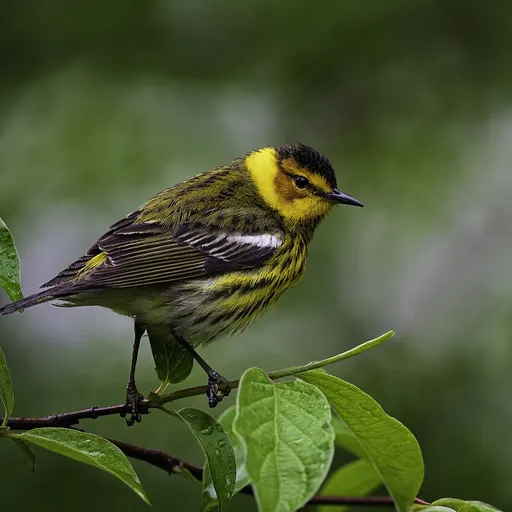
Cape May Warbler
Setophaga tigrina
Least Concern
Overview
The Cape May warbler (Setophaga tigrina) is a small, migratory New World warbler that breeds across much of southern Canada, the Great Lakes region, and New England. It winters in the West Indies and is currently listed as Least Concern by the IUCN.
Identification
- Measures 12–14 cm in length with a wingspan of 19–22 cm.
- Adult males feature a brown back, yellowish rump, and bright yellow underparts streaked with black.
- The face displays a striking chestnut patch framed in yellow with a black eyestripe, alongside a narrow white wing bar.
- Females and immature males resemble washed-out versions of the male but lack the strong head pattern.
- Song consists of a simple repetition of high tsi notes, with a thin sip call.
Habitat
This species breeds at the edges of coniferous woodland, typically nesting in dense foliage near the trunk of trees such as black spruce. Its range spans all but the westernmost parts of southern Canada, the Great Lakes region, and New England, with winters spent in the West Indies.
Diet
The Cape May warbler is insectivorous, picking insects from the tips of conifer branches or flying out to catch them. In winter, it also feeds on berry juice and nectar, using a tubular tongue to facilitate this behaviour.
Did you know?
The bird possesses a tubular tongue, a trait unique among warblers that allows it to drink nectar and eat berry juice. It can also lay the largest clutch of any New World warbler, producing 4–9 eggs in years when spruce budworm is abundant.
Sources
- Wikipedia · CC BY-SA 4.0
- Wikidata · CC0 1.0