
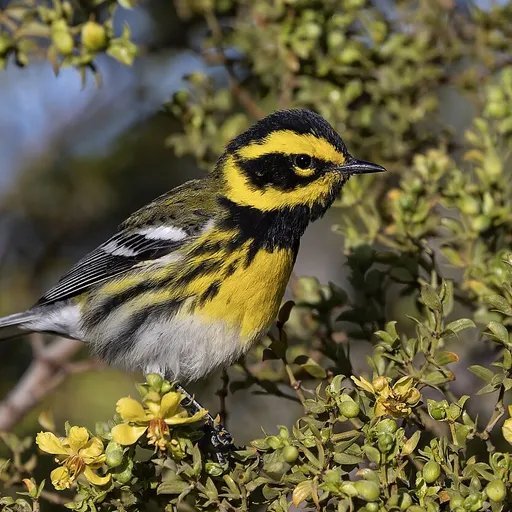
Townsend's Warbler
Setophaga townsendi
Least Concern
Listen
XC910051 · NPS Alaska · Compeau Trail, Alaska, United States · CC0 1.0
Overview
Townsend's warbler is a small songbird belonging to the New World warbler family, currently classified as Least Concern on the IUCN Red List. It is a monotypic species with no recognized subspecies and was originally described by John Kirk Townsend in 1837.
Identification
- Distinctive yellow face featuring a black stripe across the cheeks that extends into an ear patch, paired with a thin, pointed bill.
- Olive upperparts marked by black streaks on the back and flanks, contrasting with a white belly and two white wing bars.
- Adult males possess a black cap and throat with a yellow lower breast, whereas females have a dark cap and yellow throat.
- The male's song is described as a buzzed 'zee-zee-zee-bzz-zee' or 'weazy weazy weazy weazy twea', similar to the black-throated green warbler, with a sharp 'tup' call.
Habitat
This species breeds in coniferous forests with large trees on the northwestern coast of North America, where they construct shallow cup nests atop conifer branches. While some populations migrate short distances further south along the Pacific coast, others winter in Mexico, Central America, and the south-western United States.
Diet
Primarily feeding on insects, spiders, and seeds, these birds forage actively in higher branches by gleaning from foliage or hovering to catch insects in flight. Outside the nesting season, they forage in mixed flocks, supplementing their diet in winter with berries, plant nectar, and honeydew excreted by scale insects.
Did you know?
The species was named by Thomas Nuttall rather than the describer John Kirk Townsend to sidestep the convention against naming a species after oneself. The bird also interbreeds with its close relative, the hermit warbler, where their ranges overlap.
Sources
- Wikipedia · CC BY-SA 4.0
- Wikidata · CC0 1.0