
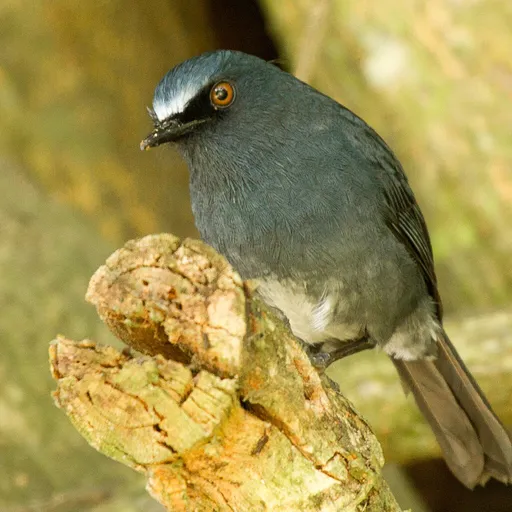
White-bellied Blue Robin
Sholicola albiventris
Near Threatened
Overview
The Sholicola albiventris, also known as the white-bellied sholakili, is a small chat-like bird endemic to the shola forests of the higher hills in southern India. Classified as Near Threatened, this species was elevated to full species status in 2005 after previously being lumped with the Nilgiri blue robin.
Identification
- Features a chunky, long-legged build with a short tail and wing.
- Displays a black face mask, a short whitish brow, and slaty blue upperparts grading to grey on the flanks.
- The centre of the belly and vent is white, though it can be confused with the white-bellied blue flycatcher by behaviour rather than plumage alone.
- Produces frequent tit-like notes and harsh rattles, with a song described as having a higher pitch and more musical quality than related species.
Habitat
Restricted to forest patches in the valleys of high-altitude grasslands known as sholas, occurring only above 1200 m in the Anaimalai and Cardamom Hills south of the Palghat gap. The species relies on a restricted and threatened habitat that is vulnerable to loss.
Did you know?
The Ashambu hills population, which was previously considered part of this species, is now recognised as a separate species, the Ashambu blue robin (Sholicola ashambuensis), estimated to have diverged from a common ancestor between 1.24 and 0.49 million years ago.
Sources
- Wikipedia · CC BY-SA 4.0
- Wikidata · CC0 1.0