
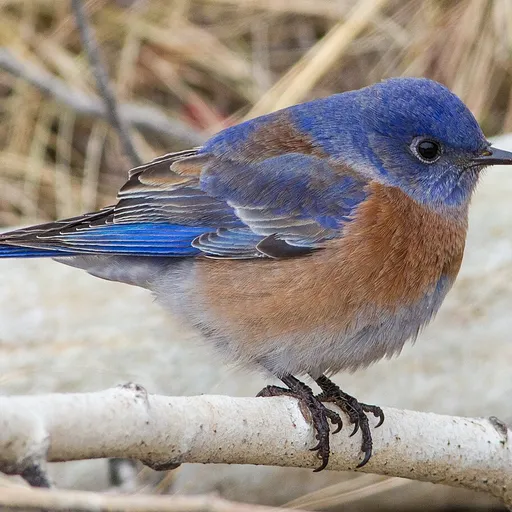
Western Bluebird
Sialia mexicana
Least Concern
Listen
XC321718 · Ryan Winkleman · Rancho Santa Margarita, Orange County, California, United States · CC BY-SA 4.0
Overview
The western bluebird (Sialia mexicana) is a small, stocky thrush native to North America. Classified as Least Concern by the IUCN Red List, the species has successfully adapted to changes in its environment despite historical displacement.
Identification
- Measures 15 to 18 cm in length with a thin, straight bill and a relatively short tail.
- Adult males display a bright blue upper body and throat, an orange breast and sides, a brownish back patch, and a gray belly.
- Adult females feature a duller blue body, wings, and tail, with a gray throat and dull orange breast.
- Immature birds exhibit duller plumage with spots on the chest and back.
- Mating calls consist of sounds like "cheer," "chur-chur," and "chup."
Habitat
Originally displaced by tree felling, the species now thrives in coniferous forests, farmlands, semi-open terrain, and desert environments. Its year-round range spans parts of the United States and Mexico, extending north to the Pacific Northwest, British Columbia, and Montana during summer breeding seasons.
Diet
This bird pounces on the ground to catch worms and berries or flies to capture aerial insects. It also waits on perches before diving down to catch prey in midair and regularly visits feeders for mealworms.
Did you know?
Genetic studies reveal that 45% of western bluebird nests contain young that are not offspring of the male partner.
Sources
- Wikipedia · CC BY-SA 4.0
- Wikidata · CC0 1.0