
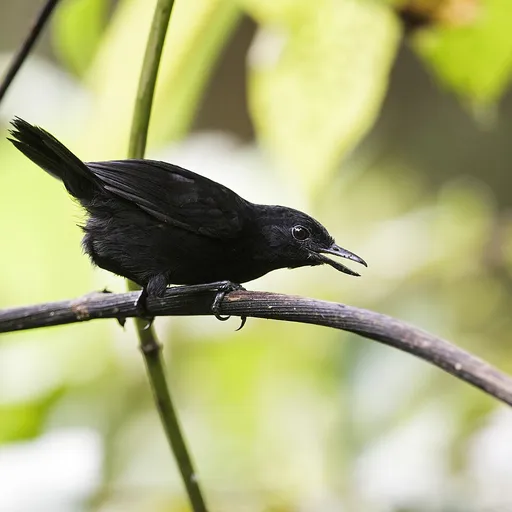
Stub-tailed Antbird
Sipia berlepschi
Least Concern
Listen
XC248208 · Niels Krabbe · Esmeraldas: 18.5 road km NNW Alto Tambo, Ecuador · CC BY-SA 4.0
Overview
The stub-tailed antbird (Sipia berlepschi) is a species of bird in the family Thamnophilidae, classified as Least Concern on the IUCN Red List. It is a monotypic species found exclusively in Colombia and Ecuador.
Identification
- Males are almost entirely black with a white patch between the scapulars, while females are mostly black with white dots on wing coverts and white spots on the throat, breast, and upper belly.
- Both sexes possess a deep red iris.
- The bird is small, measuring between 13.5 and 14.5 cm in length.
- Its song consists of a series of downslurred notes that drop and then rise in pitch, described as 'chi-chu-chu-chu-chew-chéw-chéw-chéw', accompanied by sharp 'chit' and 'ch-dit' calls.
Habitat
Found in central Chocó Department in western Colombia and northwestern Ecuador's Esmeraldas Province, the species inhabits the understorey of evergreen forest in wet lowlands and foothills. It favours forest edges, overgrown openings, and adjacent mature secondary forest, typically ranging from near sea level to 400 m, though locally reaching 650 m.
Diet
The stub-tailed antbird feeds primarily on insects and likely other arthropods, foraging in dense vegetation on the ground and up to about 2 m above it. Individuals, pairs, and family groups forage in tangled understorey near fallen logs, and while they seldom join mixed-species flocks, they occasionally attend army ant swarms to capture fleeing prey.
Did you know?
The species was resurrected into the genus Sipia in 2013 after molecular phylogenetic studies revealed that the previously assigned genus Myrmeciza was polyphyletic. Its placement in Sipia is supported by its shorter tail and distinctive foraging behaviour in tangled understorey near fallen logs.
Sources
- Wikipedia · CC BY-SA 4.0
- Wikidata · CC0 1.0