
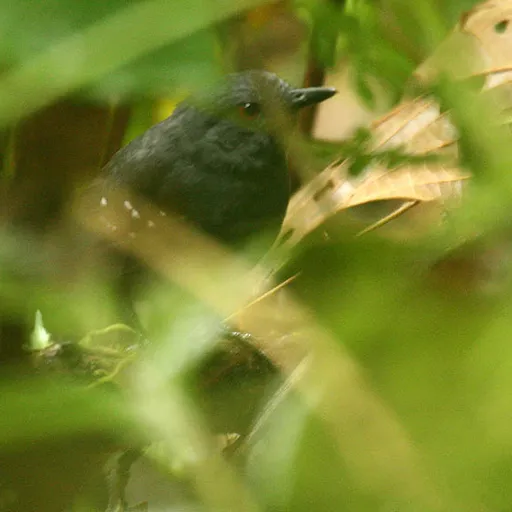
Esmeraldas Antbird
Sipia nigricauda
Least Concern
Listen
XC248242 · Niels Krabbe · Esmeraldas: El Placer, Ecuador · CC BY-SA 4.0
Overview
The Esmeraldas antbird (Sipia nigricauda) is a species of bird in the family Thamnophilidae, the typical antbirds. It is found on the Pacific slope of South America, ranging from Colombia into Ecuador.
Identification
- Length of 13 to 14 cm with a mass of 22 to 23 g, featuring a red iris in both sexes.
- Males are mostly dark gray with a white patch between the scapulars, darker wings and tail, and black wing coverts tipped in white.
- Females have dark reddish-brown upperparts, a barred black-and-white throat, a dark gray breast, and an ochre-brown belly.
- Song is a short series of high-pitched, thin, sharp notes described as 'psee-pseé-psi-psi-psi-pseé', with the second and last notes higher-pitched and emphasized.
Habitat
Found on the Pacific slope from central Chocó Department in western Colombia south into Ecuador's El Oro Province, within the Chocó Endemic Bird Area. It inhabits the floor and understorey of wet evergreen forest and adjacent mature secondary forest in the foothills, favouring ravines and slopes with dense vegetation as well as regenerating vegetation in landslide scars and tree-fall openings. Elevation ranges up to 1,200 m in Colombia and mostly between 500 and 1,100 m in Ecuador, though it can occur locally as low as 150 m and as high as 1,500 m.
Diet
Feeds primarily on insects and probably includes other arthropods. Forages individually, in pairs, or in family groups within dense vegetation on the ground and up to about 1 m above it. While it seldom joins mixed-species feeding flocks, it occasionally attends army ant swarms to capture prey that flees from the ants.
Did you know?
The species has a complex taxonomic history where the male and female were originally considered two different species because the original 1892 description was of a female; it was not until 1991 that it was realised they were the same bird, leading to the name nigricauda being retained by priority over rosenbergi.
Sources
- Wikipedia · CC BY-SA 4.0
- Wikidata · CC0 1.0