
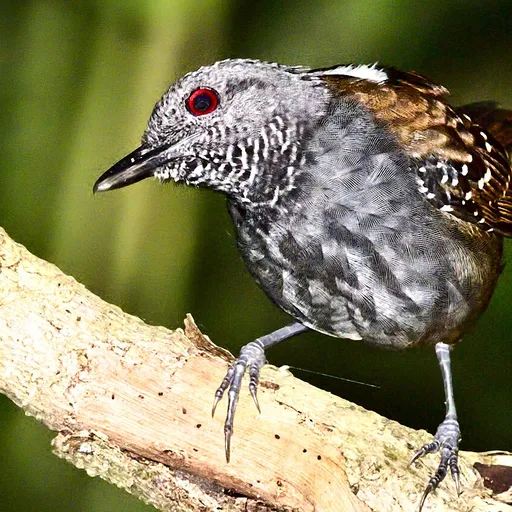
Magdalena Antbird
Sipia palliata
Near Threatened
Overview
The Magdalena antbird (Sipia palliata) is a Near Threatened species of bird in the family Thamnophilidae, found in Colombia and Venezuela. Originally described as a subspecies of the dull-mantled antbird, it was promoted to full species status in 2010 following genetic and vocal studies.
Identification
- Males have a slaty head and neck, a brown upper back with a usually hidden white patch, and chestnut lower back, rump, and tail.
- Both sexes possess dark red irises; females distinguishable by a black and white checkered throat and buff dots on wing coverts.
- The male song features a slower first section with pronounced up- and down-slurs, followed by a third section of high-pitched notes, differing from the similar dull-mantled antbird.
Habitat
This species primarily inhabits the floor and understorey of wet foothills evergreen forests, favouring ravines and slopes with dense vegetation. It ranges up to 1,100 m in elevation in Colombia and between 400 and 1,100 m in Venezuela, extending into regenerating vegetation in landslide scars and tree-fall openings.
Diet
The diet consists of insects and other arthropods such as spiders, foraged in dense vegetation mostly on the ground and up to 1 m above it. The bird seldom joins mixed-species feeding flocks but occasionally attends army ant swarms to capture fleeing prey.
Did you know?
The species was only recognised as a distinct species in 2010 after molecular and vocal studies, having previously been considered a subspecies of the dull-mantled antbird since its initial description in 1917.
Sources
- Wikipedia · CC BY-SA 4.0
- Wikidata · CC0 1.0