
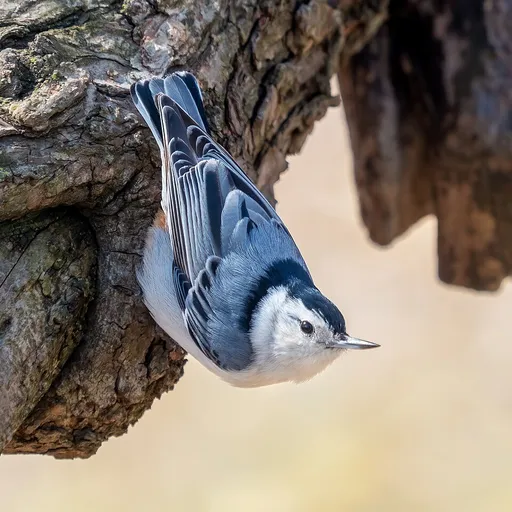
White-breasted Nuthatch
Sitta carolinensis
Least Concern
Overview
The white-breasted nuthatch (Sitta carolinensis) is a medium-sized passerine bird belonging to the family Sittidae. It is a non-migratory species that is common across much of North America, where it resides year-round in woodland habitats.
Identification
- Approximately 15.5 cm (6.1 in) in length with pale blue-grey upperparts and whitish underparts featuring a reddish tinge on the lower abdomen.
- Males possess a glossy black crown and a black band on the upper back, while females often have a dark grey crown, though some may have black caps.
- A distinctive shrill, repetitive kri-kri-kri call and a nasal mating song are characteristic vocalisations.
- White plumage completely surrounds the eye, distinguishing it from other similar nuthatch species.
Habitat
Breeding habitat consists mainly of low-elevation deciduous or mixed forests, including orchards, parks, and suburban gardens in eastern North America, while western and Mexican populations favour open montane pine and oak woodlands. The species is found throughout much of North America, ranging from southern Canada to northern Florida and southern Mexico, but is notably absent from cooler and drier regions.
Diet
This omnivorous bird forages along tree trunks and branches, often descending head-first. It consumes a wide range of arthropods, particularly insects, in the summer, but switches to a diet that may be nearly 70% seeds in winter. Large food items such as acorns or hickory nuts are wedged into crevices and hammered open with its strong beak, with surplus seeds cached under loose bark.
Did you know?
The white-breasted nuthatch has the unusual habit of removing its own faeces from its roost site in the morning. It has also been observed smearing crushed blister beetles around the entrance to its nest, likely to deter squirrels using the unpleasant smell.
Sources
- Wikipedia · CC BY-SA 4.0
- Wikidata · CC0 1.0