
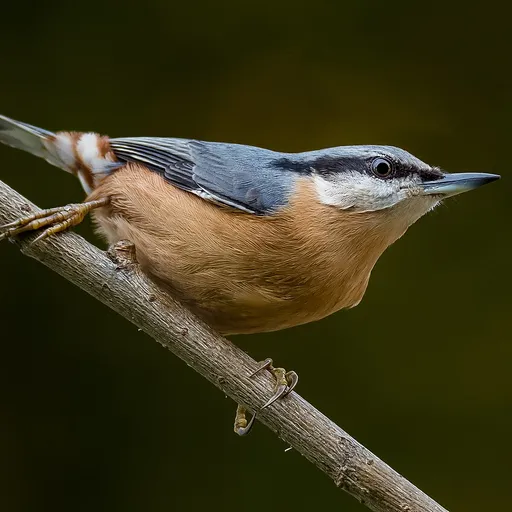
Eurasian Nuthatch
Sitta europaea
Least Concern
Listen
XC918637 · Sonothèque ADVL · Vallée du Lude (Carolles), Manche, Normandie, France · CC0 1.0
Overview
The Eurasian nuthatch is a small passerine bird found throughout the Palearctic and in Europe. It is a short-tailed species with a long bill, blue-grey upperparts, and a black eye-stripe. With more than 20 subspecies, it is classified by the IUCN as being of least concern due to its large population and huge breeding area.
Identification
- Size and structure: Approximately 14 cm long with a short, square tail, round wings, and a stout, dark grey bill that has a paler area on the base of the lower mandible.
- Plumage: Blue-grey upperparts with a distinct black eye-stripe; underparts vary by region, with western birds showing orange-buff flanks and a white throat, while Russian birds have whitish underparts.
- Vocalisations: Vocal and frequent, featuring a loud, sharp 'dwip' call normally repeated twice, a shrill 'sirrrr' alarm call, and a slow, whistled 'pee-pee-pee' song.
Habitat
This species inhabits mature deciduous or mixed woodland with large, old trees, particularly favouring oak forests, though conifers are used in parts of Russia and Taiwan. Its breeding range extends across temperate Eurasia from Great Britain to Japan, generally between the 16–20 °C July isotherms. Most populations are sedentary, though some northern and eastern breeders may move in response to poor pine cone crops.
Diet
The Eurasian nuthatch eats mainly insects, particularly caterpillars and beetles, but supplements its diet with nuts and seeds, such as hazel nuts and beech mast, during autumn and winter. It forages by descending trees head first as well as climbing, often finding food on tree trunks and large branches. It is an inveterate hoarder that stores food year-round and readily visits bird tables.
Did you know?
The name 'nuthatch' is derived from 'nut' and a word probably related to 'hack', referring to the bird's behaviour of hacking at nuts wedged into crevices. To secure their nests, females plaster the entrance with mud to reduce its size, often coating the inside of the cavity as well to make it smaller.
Sources
- Wikipedia · CC BY-SA 4.0
- Wikidata · CC0 1.0