
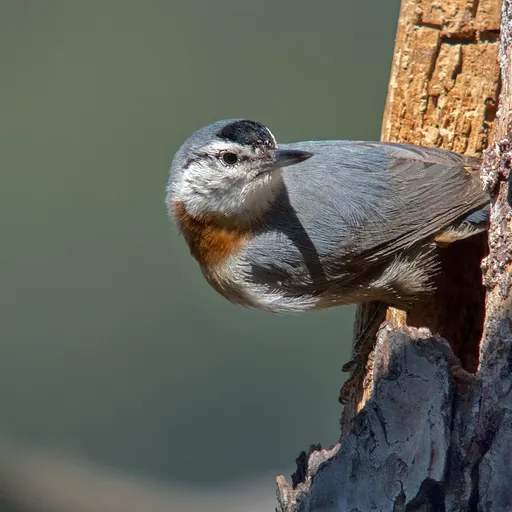
Krüper's Nuthatch
Sitta krueperi
Least Concern
Overview
Krüper's nuthatch (Sitta krueperi) is a small to medium-sized bird in the nuthatch family, Sittidae. It is found primarily in pine and other coniferous forests, closely following the distribution of the Turkish pine (Pinus brutia) across the eastern Mediterranean and western Caucasus. Although its numbers are declining due to habitat loss, the species is currently classified as 'Least Concern' by the IUCN.
Identification
- Plumage: Blue-grey upperparts with a black front crown in adults; males have blue-grey underparts while females have buff-grey underparts, both featuring a large, crescent-shaped rufous pectoral patch.
- Markings: Distinctive white supercilium underlined by a black eyestripe; undertail coverts are rufous with white tips.
- Size: Measures 12.5 cm (4.9 in) in length, with a bill length of 17.9–20.2 mm.
- Voice: Noisy and easily detected by a contact call resembling a 'dvui' or 'dui-dui-dui-dui' series, and a song described as a nasal 'tutitutitutitutituti' with alternating high and low notes.
Habitat
This species inhabits temperate coniferous forests, ranging from sea level up to 2,500 m, with a strong association with Turkish pine. Its range includes western Anatolia in Turkey, the Greek island of Lesbos, and the western Caucasus mountains in Georgia and southern Russia. In the Caucasus, it particularly prefers spruce forests between 1,000 and 2,000 m, though it is found in various conifer types including fir, cedar, and black pine.
Diet
Krüper's nuthatch feeds on insects during the breeding season, gleaning them from branches or catching them in flight. In autumn and winter, it switches to seeds, especially from pine and other conifers, which it extracts from cone scales using its bill and hammers open in tree bark. The bird also caches food to use when moisture renders pine cones inaccessible.
Did you know?
The species is notable for its territoriality even outside the breeding season, a behaviour likely driven by the need to protect food caches. It also exhibits a unique nesting behaviour where the entrance to the nest hole is not sealed with mud or resin, unlike some other nuthatch species.
Sources
- Wikipedia · CC BY-SA 4.0
- Wikidata · CC0 1.0