
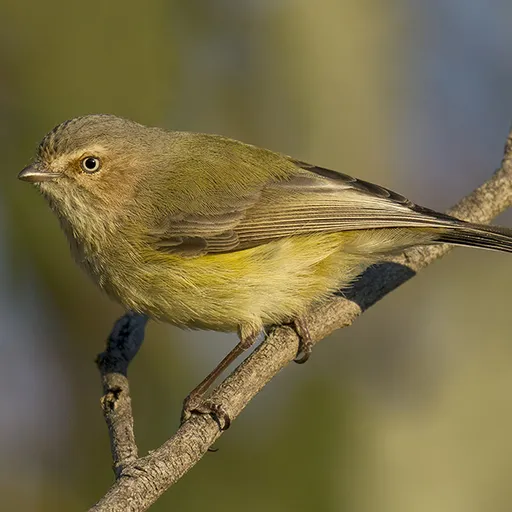
Weebill
Smicrornis brevirostris
Least Concern
Overview
The weebill (Smicrornis brevirostris) is an insectivorous passerine and Australia's smallest bird, measuring approximately 8 to 9 cm in length. Found throughout mainland Australia, it is a widespread species classified as Least Concern on the IUCN Red List.
Identification
- Plumage is nondescript, ranging from yellowish-grey on the front to olive-brownish-grey on the back, with paler, yellowish underparts in tropical regions and browner tones in the south.
- Features a short, pale grey stubby bill, pale yellow eyes, and a faint cream-coloured supercilium, with grey legs and feet.
- The voice is a loud, clear, and musical 'pee-pee p'wee, wee bit' or 'wee willy weetee', often audible from a considerable distance.
- Distinguished from similar thornbills by its stubby bill, and juveniles can be identified by their brighter yellow bills and greyer eyes.
Habitat
Weebills inhabit woodlands and forests across mainland Australia, excluding Tasmania, with a preference for the canopies of dry, open eucalyptus forests, woodlands, and mallee. They are found in all climates but tend to localise to watercourses in arid zones, remaining sedentary throughout the year.
Diet
Diet consists primarily of insects and larvae, occasionally including seeds, beetles, spiders, and flies. They forage busily in pairs or small parties, clinging to twigs and hovering to glean insects from the outer foliage of the canopy and midstory, thereby assisting in maintaining tree health.
Did you know?
Weebill nests are dome-shaped pendants suspended from branches and concealed in dense foliage, constructed using fine materials such as grasses, cobwebs, insect cocoons, and animal hair to bind and strengthen the structure.
Sources
- Wikipedia · CC BY-SA 4.0
- Wikidata · CC0 1.0