
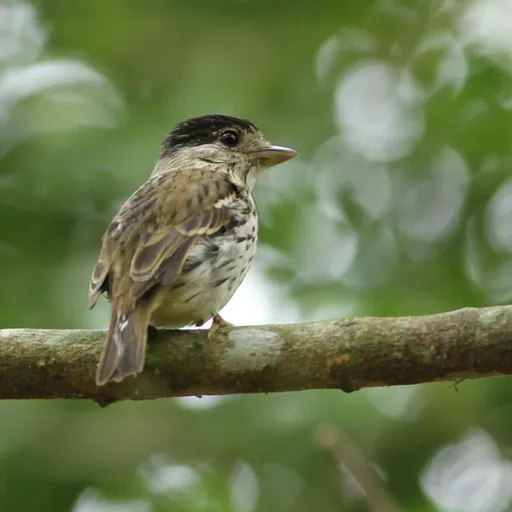
African Broadbill
Smithornis capensis
Least Concern
Listen
XC1149007 · Kileo Jumah · Endoro cave trail,Karatu,NCA, Tanzania · CC0 1.0
Overview
The African broadbill (Smithornis capensis), also known as the black-capped broadbill or Delacour's broadbill, is a stocky, flycatcher-like bird native to Africa. It belongs to the suboscine family Calyptomenidae and is currently classified as Least Concern by the IUCN, although it faces local vulnerability due to habitat loss.
Identification
- A boldly streaked, largely brown bird measuring 12–14 cm in length.
- Dark crowns that are black in males and grey in females of the eastern subspecies, or blackish in both sexes of other subspecies.
- Upperparts are olive-brown with black streaks; underparts are buff or creamy-white with black streaks on the flanks and breast.
- Produces a very loud, vibrating 'Prrrrup' sound compared to an old-fashioned car horn, generated by wing vibration during display flights.
Habitat
The species inhabits the middle stratum of evergreen or lowland forests, dense deciduous thickets, and other dense woodlands, including riverine gallery forest. Its range is restricted to Africa, featuring two separate distributions: one in coastal West Africa and a main distribution covering southern and eastern Africa from Kenya to KwaZulu-Natal.
Diet
The African broadbill feeds exclusively on invertebrates, including beetles, grasshoppers, Hemiptera, caterpillars, and spiders. It forages on the ground, in trees, and occasionally hawks prey in flight.
Did you know?
The species produces its loud call by vibrating its wings during flight, with the sound specifically generated by the sixth and seventh primary feathers.
Sources
- Wikipedia · CC BY-SA 4.0
- Wikidata · CC0 1.0