
Common Eider
Somateria mollissima
Near Threatened
Listen
XC900445 · Jochem verweij · Ottenby, Mörbylånga Municipality, Kalmar län, Sweden · CC BY-SA 4.0
Overview
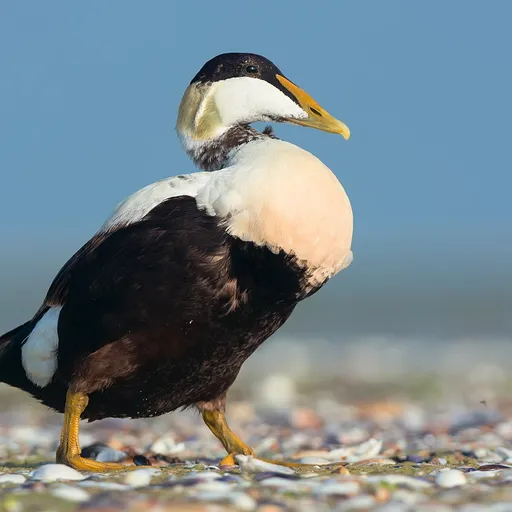
The common eider, also known as St. Cuthbert's duck, is a large sea-duck distributed over the northern coasts of Europe, North America, and eastern Siberia. It is currently classified as Near Threatened on the IUCN Red List. This species is notable for its bulky build and large, wedge-shaped bill, with males featuring distinctive black and white plumage.
Identification
- A bulky, large sea-duck measuring 50–71 cm in length, ranging from 0.81 to 3.04 kg in weight.
- Males are strikingly patterned with black and white plumage and a green nape, whereas females are entirely brown but distinguished from other ducks by their size and head shape.
- Possesses a large, wedge-shaped bill, the colour of which varies by subspecies, ranging from yellowish-green to bright orange-yellow.
- Males produce a strange, almost human-like display call described as an "ah-ooo", while females utter hoarse quacks.
Habitat
This species breeds in Arctic and some northern temperate regions but winters farther south in temperate zones, where it can form large flocks on coastal waters. It is distributed across the northern coasts of Europe, North America, and eastern Siberia, and typically nests on coastal islands in colonies that can range from less than 100 to upwards of 15,000 individuals.
Diet
The common eider forages by diving for crustaceans and molluscs, with mussels being a particularly favoured food item. It swallows mussels whole, crushing the shells in its gizzard before excreting them, and similarly consumes crab bodies after removing their claws and legs.
Did you know?
A small population of this normally strictly marine species has colonised the large freshwater lakes of land-locked Switzerland since 1988, enabled by the presence of the invasive freshwater zebra mussel. The female's nest is lined with eiderdown plucked from her own breast, a soft and warm material that has long been harvested for luxury pillows and quilts.
Sources
- Wikipedia · CC BY-SA 4.0
- Wikidata · CC0 1.0