
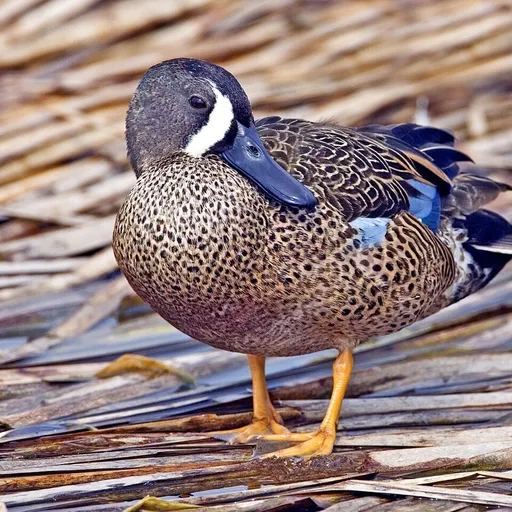
Blue-winged Teal
Spatula discors
Least Concern
Overview
The blue-winged teal is a small dabbling duck in the family Anatidae that breeds across North America, from southern Alaska to Nova Scotia, and winters from the Gulf Coast to South America. It is the most abundant duck in the mixed-grass prairies of the Dakotas and the prairie provinces of Canada. The species is classified as Least Concern on the IUCN Red List.
Identification
- Males display a greyish blue head with a white facial crescent, a light brown body, and a black tail, while females are mottled brown with a whitish area at the base of the bill.
- Both sexes possess sky-blue wing coverts, a green speculum, and yellow legs, with the yellow legs distinguishing it from similar small ducks like the common teal when found as a vagrant.
- At 40 cm long with a 58 cm wingspan and weighing around 370 g, it is one of the smaller members of the dabbling duck group.
- The male produces a short whistle, while the female emits a soft quack.
Habitat
This species prefers inland marshes, ponds, and shallow streams with dense emergent vegetation, often favoring calm water or sluggish currents over fast-flowing water. Nests are typically built on dry ground in grassy sites such as bluegrass meadows, hayfields, and sedge meadows, generally within several hundred yards of open water. It is primarily found in northern prairies and parklands but also inhabits wetlands in boreal forest associations and deciduous woodlands.
Diet
Blue-winged teals are surface feeders that forage by dabbling in shallow water, mud flats, or fields for floating and submerged vegetation. Their diet consists mainly of plant matter, including the seeds, stems, and leaves of sedges, grasses, pondweed, and duckweed, but about one-fourth of their food is animal matter such as mollusks, crustaceans, and insects. They avidly consume seeds of plants growing on mud flats, such as nutgrass, smartweed, and rice cut-grass.
Did you know?
These birds are generally the first ducks to head south in the fall and the last to return north in the spring, with adult males departing the breeding grounds well before hens and immatures. During incubation, the drake leaves his mate to moult in cover, rendering him flightless for three to four weeks.
Sources
- Wikipedia · CC BY-SA 4.0
- Wikidata · CC0 1.0