
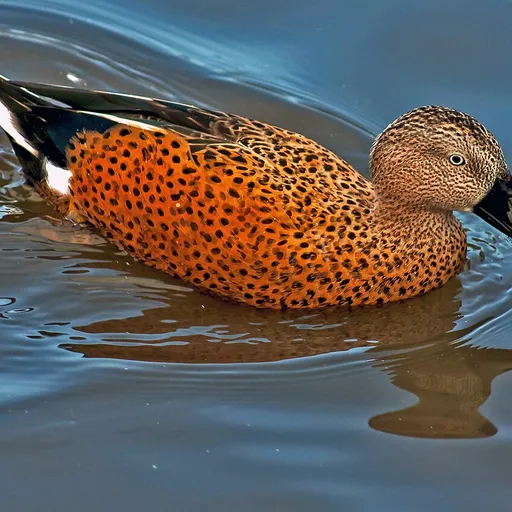
Red Shoveler
Spatula platalea
Least Concern
Overview
The red shoveler is a species of dabbling duck native to southern South America. It is a relatively common and widespread species that is classified as Least Concern on the IUCN Red List due to its large range and stable population.
Identification
- Adults range from 45 to 56 centimetres in length with a wingspan of 66 to 73 centimetres.
- The bill is distinctively spatula-shaped, equipped with a lamellate filtering mechanism.
- Males vary in colour from red to paler shades of red and pink, while females tend to have large, dark bills.
- The plumage features a green speculum and light blue upper wing coverts.
Habitat
This species inhabits shallow lakes and pools with dense reed beds, intertidal mangrove swamps, marshes, and brackish waters such as coastal lagoons, deltas, and estuaries. Its range covers the southern half of South America, extending from Tierra del Fuego northwards to Chile, most of Argentina, and the Falkland Islands, with isolated populations in southern Peru, Bolivia, Paraguay, and extreme southern Brazil and Uruguay.
Diet
Red shovelers consume herbs, grasses, pond weeds, widgeon grass, algae, eelgrass, and small invertebrates. They utilise the lamellate filtering mechanism of their spatula-shaped bill to extract small items of food from the water.
Did you know?
Pairs form in the wintering grounds following often noisy courtship displays. After a clutch of seven to eight eggs is laid, incubation lasts approximately 25 to 26 days, followed by a fledging period of 40 to 45 days.
Sources
- Wikipedia · CC BY-SA 4.0
- Wikidata · CC0 1.0