
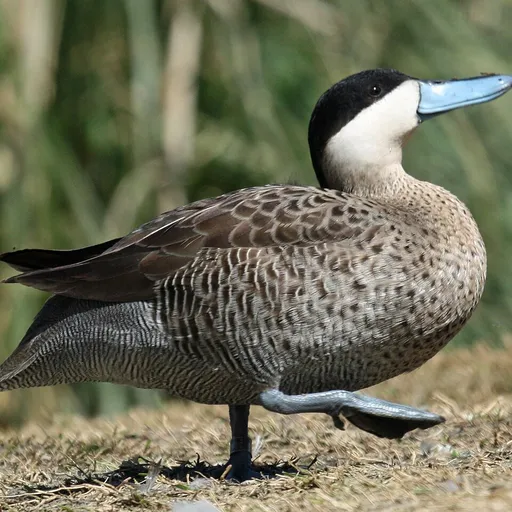
Puna Teal
Spatula puna
Least Concern
Overview
The Puna teal (Spatula puna) is a species of dabbling duck in the family Anatidae, found in high-altitude wetlands. Previously regarded as a subspecies of the silver teal, it is now recognised as a distinct species following molecular phylogenetic studies. It is classified as Least Concern on the IUCN Red List, with a stable population estimated between 100,000 and 1,000,000 individuals.
Identification
- Adult males feature a blackish-brown cap extending below the eyes, a creamy white lower face, and a coffee-colored body marked with dark brown spots that turn into bars on the back and flanks.
- They possess a distinctive light blue bill with a black nail and culmen, contrasting with their gray legs and feet.
- The species measures approximately 48 cm in length, making it slightly larger than the silver teal, with an iridescent green speculum bordered by black and white bars.
- Vocalisations include a short "decrescendo" call of four to five notes, alongside a low, chatting sound and a mechanical, rising trill.
Habitat
This non-migratory bird is resident in the Puna zone of the Andes, ranging from central Peru through western Bolivia and northern Chile into extreme northwestern Argentina. It inhabits high-altitude freshwater wetlands, specifically weakly alkaline lakes, swamps, and bogs at elevations up to 4,600 m, favouring areas with abundant floating vegetation such as the aquatic plant Chara.
Diet
Puna teal primarily feed on plants and seeds but also consume invertebrates. As dabbling ducks, they forage by tipping forward in the water until they are upside down, using plates called lamellae along the edges of their bills to remove food from the bottom of ponds and lakes.
Did you know?
To cope with the thin air at high altitudes, the Puna teal has evolved respiratory adaptations, including larger mass-specific lung volumes and a higher proportion of blood vessels in their lungs, allowing for more efficient oxygen uptake.
Sources
- Wikipedia · CC BY-SA 4.0
- Wikidata · CC0 1.0