
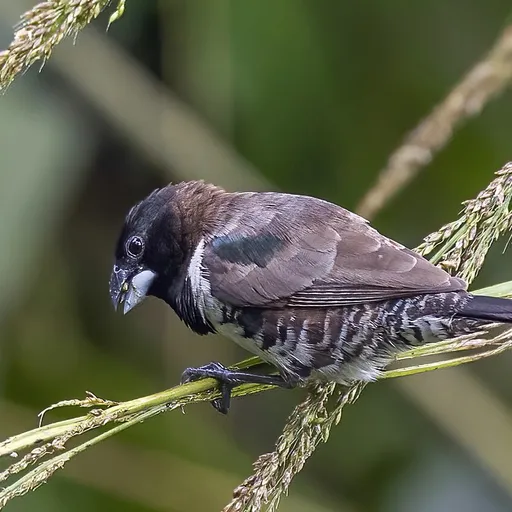
Bronze Mannikin
Spermestes cucullata
Least Concern
Overview
The bronze mannikin, or bronze munia (Spermestes cucullata), is a small passerine bird of the Afrotropics. It is the smallest and most widespread of the four munia species found on the African mainland.
Identification
- Length of 9–10 cm with a compact body, short black tail, and stubby black and pale grey mandibles.
- Black to brownish black head, chin, and throat with purple-green iridescence on the face and sides of the breast.
- Greyish brown upper parts and white underparts featuring irregular barring on the flanks and rump.
- Calls include a 'rreep-rreeep' in flight and a twittering of wheezy or buzzing notes when perched.
Habitat
Found across much of Africa south of the Sahara Desert, as well as the Bioko, Pemba, Zanzibar, Mafia, and Comoro islands, and introduced to Puerto Rico. It inhabits mesic savanna or forest margin habitats and is resident, nomadic, or irruptive throughout its range.
Diet
This gregarious bird feeds mainly on seeds, including wild grass seeds, millet, rice, and grain. It may also consume termites, nectar, or strands of algae. Before roosting, flocks often visit watering holes where vegetation hangs into the water.
Did you know?
The birds construct slovenly, ball-shaped communal roosting nests that are dismantled for material reuse and rebuilt almost daily. Each roosting party of eight to twenty birds is dominated by a single adult male who defends the area against intruders.
Sources
- Wikipedia · CC BY-SA 4.0
- Wikidata · CC0 1.0