
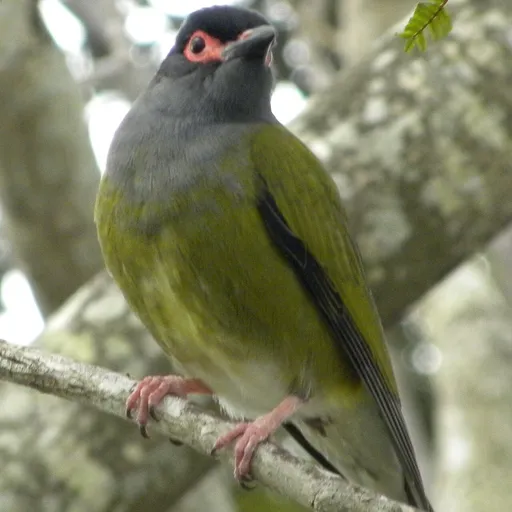
Australasian Figbird
Sphecotheres vieilloti
Least Concern
Overview
The Australasian figbird (Sphecotheres vieilloti) is a conspicuous, medium-sized passerine bird native to northern and eastern Australia, southern New Guinea, and the Kai Islands. Also known as the green figbird, it is common in large parts of its range and is currently rated as least concern by BirdLife International and the IUCN.
Identification
- Males possess a black head with distinct bright red facial skin, a black bill with a red base, pinkish legs, and a black tail with broad white tips to the outer feathers.
- In the nominate subspecies, the body is largely olive-green with a grey throat, neck, and chest, while other subspecies feature bright yellow underparts.
- Females are drab, appearing dull brownish above and white below with strong dark streaking, differing from males by having greyish facial skin and a greyish-black bill.
- The bird has a jizz comparable to other orioles, a total length of 27.0–29.5 cm, and a body mass of 111–130 g, making it likely the largest of the Old World orioles.
Habitat
This species inhabits a wide range of wooded environments across northern and eastern Australia, southern New Guinea, and the Kai Islands. It is largely a resident species, although the southern population may be migratory, and is considered nomadic in response to food availability.
Diet
Australasian figbirds are largely frugivorous but also consume small insects, nectar, and small seeds. Unlike most orioles, they are gregarious, often forming flocks of 20 to 40 birds during the non-breeding season to forage together.
Did you know?
Australasian figbirds can mimic the voices of other birds, including parrots and other species of orioles. They may also gain protection from nest predators by nesting near aggressive species such as the spangled drongo and helmeted friarbird.
Sources
- Wikipedia · CC BY-SA 4.0
- Wikidata · CC0 1.0