
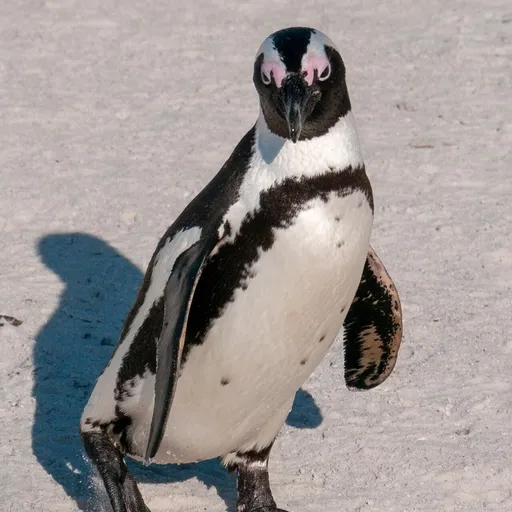
African Penguin
Spheniscus demersus
Critically Endangered
Overview
The African penguin (Spheniscus demersus), also known as the Cape or South African penguin, is a flightless seabird confined to southern African waters and is the only penguin species found in the Old World. Classified as critically endangered, it is the rarest penguin species, with populations declining rapidly due to habitat loss, overfishing, and climate change.
Identification
- Adults are 60–70 cm tall with black upperparts and white underparts marked by a single black band.
- Possesses distinctive pink patches of skin above the eyes that flush with increased blood flow when hot.
- A thick black band in the shape of an upside-down horseshoe runs across the chest and throat.
- Produces loud, donkey-like braying noises, leading to the vernacular name 'jackass penguin'.
Habitat
Found along the southern and southwestern coast of Africa, living in colonies on islands between Namibia and Algoa Bay, South Africa. It is the only penguin species that breeds in Africa, though recent mainland colonies exist near Cape Town and in Namibia.
Diet
A pursuit diver that feeds primarily on pelagic fish such as sardines, anchovies, and mullet, as well as squid and small crustaceans. Foraging typically occurs within 20 km of the shore, with dives averaging 25 m in depth and lasting around 69 seconds.
Did you know?
The pink patches of skin above the eyes contain sweat glands that help cool the birds' blood; as the temperature rises, increased blood flow causes these glands to become visibly pinker.
Sources
- Wikipedia · CC BY-SA 4.0
- Wikidata · CC0 1.0