
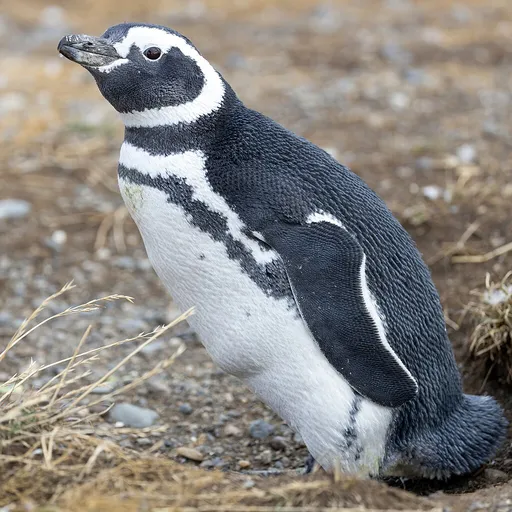
Magellanic Penguin
Spheniscus magellanicus
Least Concern
Overview
The Magellanic penguin is a medium-sized South American penguin that breeds in coastal Patagonia and is the most numerous of the banded penguin species. It is listed as Least Concern by the IUCN, although its population is currently decreasing due to factors such as oil spills and climate change.
Identification
- Medium-sized penguins standing 61–76 cm tall and weighing between 2.7 and 6.5 kg.
- Adults feature black backs and white abdomens with two distinct black bands on the chest, the lower one shaped like an inverted horseshoe.
- The head is black with a broad white border running from behind the eye around the chin to the throat.
- Young birds have grey-blue backs and blotched feet, which fade to all-black by around ten years of age.
Habitat
Breeding occurs in coastal Patagonia, including Argentina, Chile, and the Falkland Islands, where large nesting colonies form at densities of up to 20 nests per 100 square metres. During winter, they migrate north to feed in waters offshore from Peru and Brazil. Vagrants have occasionally been recorded as far north as El Salvador and as far south as Antarctica.
Diet
These penguins forage in the water, diving to depths of 20 to 50 metres to catch small pelagic fish, squid, krill, and squat lobsters. They travel in large groups when hunting and rely on a consistent food supply located on the Atlantic coast of South America. Jellyfish are also actively sought out as a food item rather than being ingested accidentally.
Did you know?
Females can recognise their mates through their call alone, enabling the pair to reconnect after the male reclaims his burrow for the new breeding season.
Sources
- Wikipedia · CC BY-SA 4.0
- Wikidata · CC0 1.0