
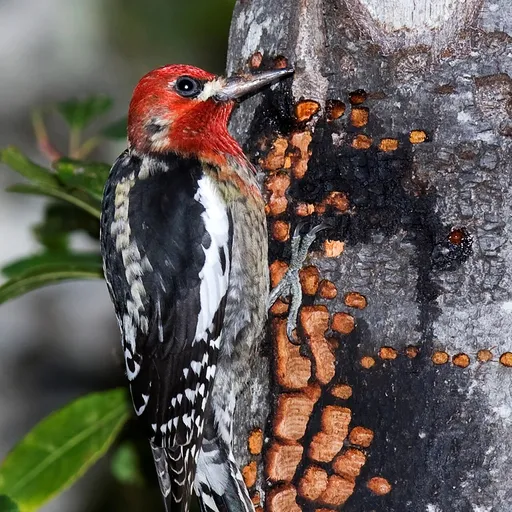
Red-breasted Sapsucker
Sphyrapicus ruber
Least Concern
Overview
The red-breasted sapsucker (Sphyrapicus ruber) is a medium-sized woodpecker found in the forests of the west coast of North America. It is classified as Least Concern on the IUCN Red List and is one of four species currently placed in the genus Sphyrapicus.
Identification
- Red head and upper chest with a white lower belly and rump.
- Black back and wings featuring white wing barring, with yellow bars on the back for northern subspecies and white bars for southern subspecies.
- Vocalisations include variety of chatter, squeals, and scream-like calls, supplemented by drumming with the bill.
Habitat
These birds breed in forests containing pine, hemlock, Douglas fir, fir, and spruce, with a preference for old-growth woodland that provides living trees. Their range extends from southeast Alaska and British Columbia south through the Pacific Coast Ranges to northern California, with winter migration reaching as far south as Baja California in Mexico.
Diet
Feeding relies on sap collected via a tongue adapted with stiff hairs, as well as insects attracted to the sap. The birds drill holes in neat horizontal rows on the same trees, returning periodically to feed as the sap begins to flow.
Did you know?
Repeated visits by sapsuckers to drill holes in the same trees can eventually kill the host tree. This foraging behaviour benefits other species, such as rufous hummingbirds, which follow sapsuckers to consume the insects attracted to the sap.
Sources
- Wikipedia · CC BY-SA 4.0
- Wikidata · CC0 1.0