
Williamson's Sapsucker
Sphyrapicus thyroideus
Least Concern
Overview
The Williamson's sapsucker (Sphyrapicus thyroideus) is a medium-sized woodpecker belonging to the genus Sphyrapicus. This species is classified as Least Concern on the IUCN Red List, although it faces threats from habitat loss in specific regions.
Identification
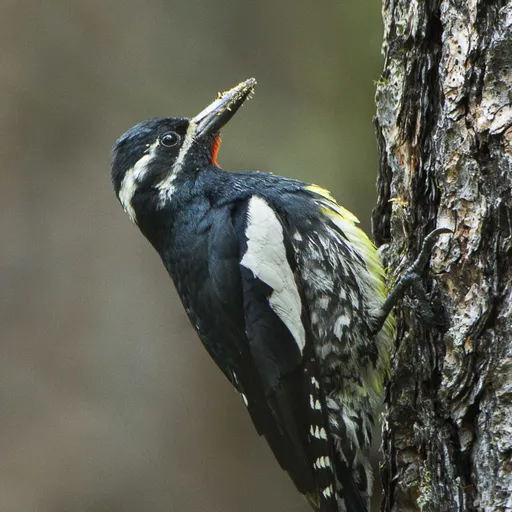
- Adult males are iridescent black on the head, back, sides, and tail, featuring a white stripe behind the eye, a lower white stripe across the head, a red chin, and a bright yellow belly.
- Males have black wings with large white patches, while females are mainly black with a pale yellow breast, a brownish streaked head, and fine barring on the back, breast, and sides.
- The bird measures 8.3–9.8 in (21–25 cm) in length with a 17 in (43 cm) wingspan.
- Males and females differ significantly in appearance, a distinction that led to the female originally being misidentified as a separate species.
Habitat
Breeding habitat consists of open forested areas with conifers, mainly ponderosa pine, douglas-fir, and grand fir, with subalpine fir and western larch also serving as important components. The species breeds in western North America from northern Mexico to British Columbia, with some populations being permanent residents while others migrate south to central Mexico. In south-central British Columbia, the species is associated with mature larch forests and is designated endangered due to rapid habitat loss.
Diet
These birds feed primarily on sap from conifers but rely on insects as their main food source during the nesting season. Outside of the breeding period, they also consume berries.
Did you know?
The female was originally considered a separate species and named the black-breasted woodpecker by Cassin in 1852, while the male was described in 1857 as Picus williamsonii; it was not until 1873 that Henry Henshaw clarified they were the same species. The species is named after Lieutenant Robert Stockton Williamson, who led the surveying expedition that collected the first male specimen while identifying a railway route to the Pacific Ocean.
Sources
- Wikipedia · CC BY-SA 4.0
- Wikidata · CC0 1.0