
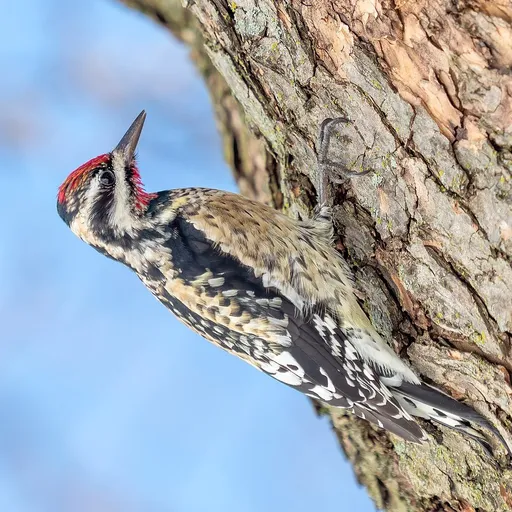
Yellow-bellied Sapsucker
Sphyrapicus varius
Least Concern
Listen
XC175237 · Jonathon Jongsma · Miesville Ravine Park Reserve, Goodhue County, Minnesota, United States · CC BY-SA 4.0
Overview
The yellow-bellied sapsucker (Sphyrapicus varius) is a medium-sized woodpecker that breeds in Canada and the northeastern United States. It is classified as a species of least concern by the IUCN, despite a decreasing population, owing to its large range of approximately 7,830,000 square kilometres.
Identification
- Size and build: Medium-sized bird measuring 19 to 21 cm in length with a wingspan of 34 to 40 cm.
- Plumage: Features a bright red forehead and crown in males (lighter red in females), a white stripe extending from above the eye to the nape, and yellow-tinged underparts transitioning to white.
- Bill and legs: Possesses a relatively short, straight, chisel-tipped bill that is slate to blackish in colour, and legs that range from blue-grey to green-grey.
- Vocalisations: Mates are attracted by a long-distance nasal "neaaah" or "owee-owee", while a scratchy "quirk" is used when pairs meet at the breeding territory.
Habitat
During the breeding season, this species inhabits deciduous and mixed coniferous forests up to 2,000 metres in altitude. In the non-breeding season, it utilises forests, open woodland, and semi-open habitats, ranging in elevation from sea level to 3,400 metres. Its range spans Canada, eastern Alaska, and the northeastern United States, with wintering grounds in the eastern United States, the West Indies, and Central America.
Diet
The diet primarily consists of arthropods, tree sap, fruits, and nuts, with bast and cambium also being consumed. Sap is the primary food source during late summer and autumn, while cambium is eaten throughout the year, particularly in winter and spring. Foraging involves drilling exploratory horizontal bands near live branches to create vertical columns of holes that yield phloem sap and bast.
Did you know?
The species exhibits low genetic diversity, possessing only about half that of most other birds. This lack of genetic variety exists despite the bird being common across its large range.
Sources
- Wikipedia · CC BY-SA 4.0
- Wikidata · CC0 1.0